How Customs Value Is Determined in South Africa

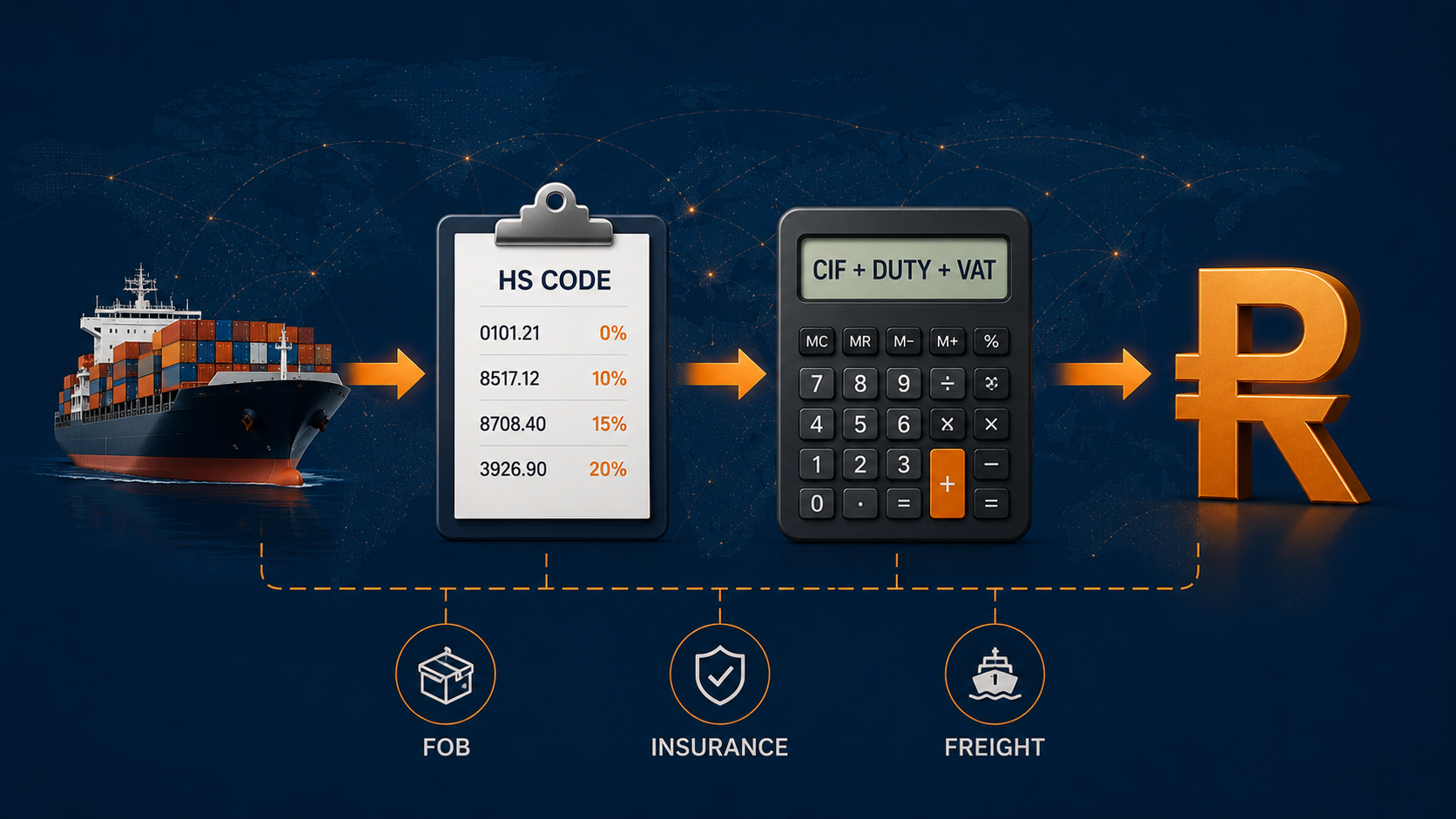
Customs value is the number SARS uses to calculate duty and VAT on every import entering South Africa. It is based on the WTO Valuation Agreement, applied through six methods in a fixed order, with FOB (Free on Board) as the standard valuation basis. This guide explains how each step works, how VAT is calculated through the Added Tax Value (ATV), and what happens when SARS questions your declared price.
In This Guide
- The quick version
- What “customs value” means
- The six valuation methods (applied in order)
- FOB: the valuation base South Africa uses
- Import VAT and the ATV formula
- What happens when SARS questions your price?
- Where tariff codes fit in
- Worked example: customs value to total landed cost
- How SSS handles customs value for you
- FAQs
The quick version
Customs value is the base figure SARS uses to calculate duty and the Added Tax Value (ATV) that determines your import VAT. South Africa values most shipments on an FOB basis, meaning the goods plus all costs up to loading on the export carrier. International freight and insurance are excluded.
SARS follows the WTO Agreement on Customs Valuation using six methods applied in strict sequence. The first method, transaction value (your actual invoice price on FOB terms), covers the vast majority of imports.
VAT is calculated on the ATV, not just the invoice. The formula: Customs Value + Duty + 10% of Customs Value, then multiply by 15%. If SARS believes your declared price is too low, it can switch methods or apply an uplift to reach a value it considers fair.
What “customs value” means
Customs value is the figure SARS accepts as the taxable base for your import. It might be exactly what you paid, or it might be a value derived from market data if SARS considers your invoice price unreliable.
South Africa implements the WTO Valuation Agreement (sometimes called the GATT Valuation Code) through the Customs and Excise Act. The agreement sets out six methods, applied in a fixed hierarchy. SARS must try Method 1 before moving to Method 2, and so on.
The core principle: customs value should reflect the real economic value of the goods at the point of export, not an inflated or deflated figure.
The six valuation methods (applied in order)
SARS applies these in sequence. It cannot skip to a later method unless the earlier ones have been ruled out.
Method 1: Transaction value
The price actually paid or payable for the goods, adjusted to FOB terms. This is the default for the majority of imports. It works when you have a genuine arm’s-length sale with a clear invoice.
Method 2: Transaction value of identical goods
SARS compares your shipment to recent imports of the same goods (same country, same producer where possible). Used when Method 1 fails, for example if the sale is between related parties and the price looks suspect.
Method 3: Transaction value of similar goods
Same principle as Method 2, but using goods that are not identical, just commercially interchangeable. Think same function, same materials, produced in the same country.
Method 4: Deductive method
Works backwards from the local selling price in South Africa. SARS deducts local costs (profit, transport, duties) to arrive at a customs value. Often used for goods with no comparable import data.
Method 5: Computed method
Builds the value from production cost plus profit and general expenses. Rarely used because it requires detailed cost data from the foreign manufacturer, which SARS has limited power to obtain.
Method 6: Fall-back method
A flexible application of the above methods, with reasonable adjustments. This is the last resort and gives SARS the most discretion.
Reference: SARS Customs Valuation overview.
FOB: the valuation base South Africa uses
South Africa values imports on an FOB (Free on Board) basis. This means the customs value includes the goods themselves plus all costs incurred up to the point where they are loaded onto the export carrier in the country of origin.
FOB excludes international freight and cargo insurance. If your supplier invoice bundles CIF (Cost, Insurance, Freight) terms, SARS will strip out the freight and insurance components to arrive at the FOB value.
Practical tip: Always ask your supplier for a separate freight line on the invoice. A clean FOB breakdown avoids delays at customs and makes duty calculation straightforward.
This differs from countries like the EU and Australia, which value imports on a CIF basis (freight and insurance included). South Africa’s FOB approach generally results in a lower customs value, and therefore lower duty, than CIF-based countries applying the same duty rate.
Related: How to import goods to South Africa: a complete guide
Import VAT and the ATV formula
Import VAT in South Africa is 15%, but it is not calculated on the customs value alone. SARS uses the Added Tax Value (ATV) as the VAT base.
The ATV formula:
ATV = Customs Value + Duty + 10% of Customs Value
Import VAT = ATV x 15%
The extra 10% loading on customs value is meant to account for costs not captured in the FOB figure (freight, insurance, handling). It is a flat uplift applied to all imports regardless of actual shipping costs.
ATV worked into a real number
Say your customs value is R10,000 and the duty rate is 30%.
| Component | Calculation | Amount |
|---|---|---|
| Customs value (FOB) | Invoice price on FOB terms | R10,000 |
| Duty at 30% | R10,000 x 30% | R3,000 |
| 10% uplift | R10,000 x 10% | R1,000 |
| ATV | R10,000 + R3,000 + R1,000 | R14,000 |
| VAT at 15% | R14,000 x 15% | R2,100 |
| Total tax payable | Duty + VAT | R5,100 |
Some goods moving within the BLNS (Botswana, Lesotho, Namibia, Eswatini) customs union have different treatment. For standard international imports, the formula above applies.
What happens when SARS questions your price?
If SARS believes the declared transaction value is abnormally low, it does not simply accept the invoice and move on. It has two main tools.
Moving down the methods list
SARS can reject Method 1 (transaction value) and apply Method 2, 3, 4, 5, or 6 in sequence. In practice, this usually means comparing your price to identical or similar goods that cleared at higher values.
Applying a customs uplift
SARS may apply an uplift (sometimes called an “upliftment”) to adjust the customs value upward. This increases both duty and VAT through the ATV. Even if the tariff line carries a 0% duty rate, an uplift still increases VAT because of the 10% loading in the ATV formula.
Watch out: Undervaluing goods to save on duty is a false economy. SARS actively monitors declared values against trade data. An uplift means you pay more than you would have with a correct declaration, and repeated undervaluation can trigger audits and penalties.
Where tariff codes fit in
Your tariff classification (HS code) determines which duty rate applies to your customs value. South Africa uses the Harmonised System maintained by the World Customs Organisation, with local sub-headings added by SARS.
Getting the HS code right matters for three reasons:
Duty accuracy. The wrong code can mean paying 45% instead of 0%, or the reverse, both of which create problems. Overpaying ties up cash. Underpaying creates a liability when SARS audits.
Clearance speed. A misclassified shipment gets flagged for review. That means delays, physical inspection, and potential storage charges while SARS sorts it out.
Regulatory compliance. Some HS codes trigger permit requirements, health certificates, or NRCS (compulsory specifications) checks. Using the wrong code can land you with goods stuck at the port that need permits you never applied for.
Related: 5 common importing mistakes and hidden costs in South Africa
Worked example: customs value to total landed cost
Here is a simplified breakdown for a personal import: a laptop bought from a US retailer for $800 (approximately R14,400 at R18/USD). Importing electronics like laptops is one of the most common categories SSS handles. Our guide on importing electronics to South Africa covers the practical details.
| Step | Detail | Amount (ZAR) |
|---|---|---|
| FOB value | Purchase price converted at SARS exchange rate | R14,400 |
| HS code | 8471.30 (portable computers) | – |
| Duty rate | 0% (laptops are duty-free) | R0 |
| 10% uplift | R14,400 x 10% | R1,440 |
| ATV | R14,400 + R0 + R1,440 | R15,840 |
| VAT at 15% | R15,840 x 15% | R2,376 |
| Total tax | Duty + VAT | R2,376 |
Even on a duty-free item, VAT still applies through the ATV. That R2,376 is the minimum tax payable before shipping, handling, and clearance fees are factored in. For a broader view of what the full landed cost looks like across different product types, see our guide on international online shopping costs.
SSS includes all of this in a single upfront quote. No surprises at delivery.
How SSS handles customs value for you
Scott’s Shipping Services is an end-to-end import service. We handle purchasing, international shipping, customs clearance, duties, VAT, and delivery as one all-inclusive quote. Here is how that connects to customs value specifically.
Accurate FOB declarations. We work directly with sellers to ensure invoices reflect clean FOB values. That means no guesswork on the customs value, and no reason for SARS to query the shipment.
Correct tariff classification. Every shipment gets the right HS code before it ships. We document the classification rationale so clearance is clean and there is a paper trail if SARS asks questions later.
ATV and VAT calculated upfront. Your quote includes the duty, the 10% uplift, and the VAT calculated on the full ATV. The number you see is the number you pay.
Complete documentation. Invoices, packing lists, and Incoterms aligned to the valuation method. SARS gets exactly what it expects, which keeps clearance fast.
One point of contact. From the seller’s warehouse to your door in South Africa, one team handles the entire chain. No finger-pointing between freight forwarders, brokers, and couriers. For a full overview of what this means in practice, see our post on the benefits of using an import company.
Frequently asked questions
Is international freight and insurance included in customs value?
No. South Africa uses FOB as its valuation basis. International freight and cargo insurance are excluded from customs value. The 10% uplift in the ATV formula is a flat proxy for these costs when calculating VAT.
Why did SARS ignore my invoice price?
SARS can reject Method 1 (transaction value) if the declared price looks out of line with comparable trade data. It then moves to identical goods, similar goods, deductive, computed, or fall-back methods in sequence. You may also receive a customs uplift that adjusts the value upward.
How do I calculate VAT on imports?
Use the ATV formula. Add the customs value, duty, and 10% of customs value together to get the ATV. Multiply by 15% for the VAT amount. Example: R10,000 customs value + R3,000 duty + R1,000 uplift = R14,000 ATV. VAT = R14,000 x 15% = R2,100.
Do low-value online orders skip customs?
No. South Africa has tightened enforcement on low-value parcels. VAT applies regardless of value, and SARS applies extra scrutiny to categories commonly associated with undervaluation (electronics, clothing, cosmetics). Correct classification and honest declarations are required even on small orders.
What is the difference between FOB and CIF?
FOB (Free on Board) includes the goods and costs up to loading on the export carrier. CIF (Cost, Insurance, Freight) adds international shipping and insurance on top. South Africa uses FOB for customs valuation, while countries like the EU use CIF. The practical effect: the same goods valued on CIF terms would have a higher customs value, and therefore higher duty, than on FOB terms.
Can SSS handle the customs valuation process for me?
Yes. SSS manages the entire import chain from purchase to delivery, including customs declarations, tariff classification, and duty/VAT payment. Your quote is all-inclusive, so the customs value calculation is handled before you commit to the purchase. Get a quick estimate to see your landed cost upfront.
Useful resources
SARS: Customs Valuation overview
WTO Agreement on Customs Valuation
SSS: How to import goods to South Africa
SSS: 5 common importing mistakes and hidden costs
Planning your next import? Use our online calculator for a quick estimate, or get in touch for advice on your shipment.