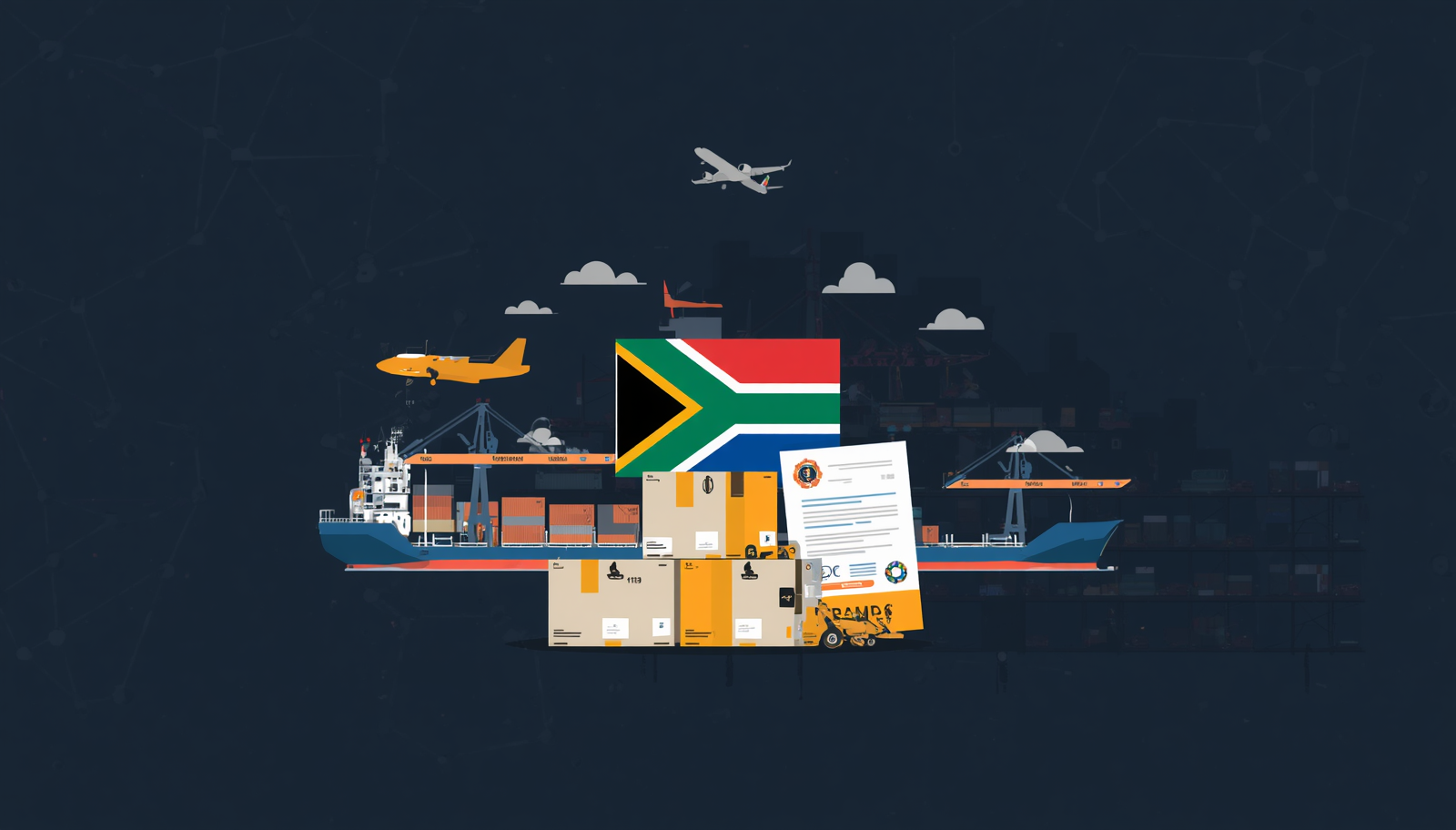
Importing Goods to South Africa: What It Costs and How It Works

Every year, thousands of South Africans order products from overseas retailers, only to hit a wall when the parcel reaches customs. Duties, VAT, courier surcharges and unclear timelines turn what looked like a bargain into an expensive headache. This guide breaks down exactly what importing goods to South Africa costs, how duties and VAT are calculated, and how to avoid the common traps that catch most first-time importers.
In This Guide
Why are South Africans importing more than ever?
The short answer: selection and price. Many products sold internationally are either unavailable locally, heavily marked up by local resellers, or months behind on release dates. Electronics, auto parts, speciality health products, clothing brands, hobby gear and industrial components are among the most commonly imported categories.
South African consumers and small businesses have worked out that buying directly from retailers in the USA, UK, China, Germany and the UAE often saves 30% to 60% compared to local retail, even after shipping and duties are factored in.
The catch is that “buying” is the easy part. Getting the goods through customs, paying the correct duties, and having them delivered to your door without delays or surprise charges is where most people get stuck.
What does it cost to import goods to South Africa?
The total landed cost of an imported item is made up of several components. Understanding each one prevents surprises at delivery.
The cost breakdown
| Cost Component | What It Covers |
|---|---|
| Product price | The purchase price from the overseas retailer, converted to ZAR |
| International shipping | Courier or freight charges from the seller’s country to South Africa |
| Customs duty | A percentage of the declared value, set by SARS based on the product’s tariff code |
| VAT | 15% on the combined value of the product, shipping, and duty |
| Clearance and handling | Fees charged by the clearing agent or courier for processing the customs declaration |
| Local delivery | The final-mile courier from the port of entry to your door |
When you buy from an overseas retailer and arrange your own shipping, each of these costs arrives separately and often without warning. Duty rates depend on the product classification (tariff heading), and getting the classification wrong can result in delays, penalties, or your parcel being held at customs.
How do customs duties and VAT work?
Every item entering South Africa is subject to assessment by SARS (South African Revenue Service). The process works like this:
The courier or clearing agent submits a customs declaration that includes the product description, its value, the country of origin, and the applicable tariff code. SARS uses this information to calculate the duty owed. VAT at 15% is then applied on top of the product value, the shipping cost, and the duty combined.
Duty rates vary widely. Some goods attract 0% duty (certain raw materials, for example), while others can reach 40% or higher (clothing and textiles are notoriously expensive to import). The rate depends entirely on the tariff heading assigned to the product, which is drawn from the Harmonised System used internationally. For a deeper look at how SARS calculates what you owe, see our guide to how customs value is determined in South Africa.
This is where many DIY importers get caught. If the tariff code on the declaration is wrong, SARS can reject the entry, hold the goods for inspection, or apply a higher rate. Correcting errors after the fact costs time and money.
What can (and can’t) you import?
Most consumer goods can be legally imported into South Africa, but there are restrictions and outright bans worth knowing about before you buy. For a full rundown of popular product categories, see our guide to what South Africans commonly import.
Commonly imported goods
Electronics and computer components, auto parts and accessories, clothing and footwear, health and beauty products, hobby and craft supplies, tools and industrial equipment, and children’s toys are all regularly imported by SSS clients.
Restricted or prohibited items
Certain items require permits or are banned entirely. These include firearms and weapons, certain medications and supplements (depending on SAHPRA regulations), counterfeit goods, hazardous materials, and some agricultural products. If you’re unsure whether a specific product can be imported, it’s worth checking before you buy.
SSS reviews every order before purchase and will flag any compliance issues upfront, so you don’t waste money on something that can’t clear customs.
The real risks of importing on your own
Plenty of South Africans have ordered directly from an overseas store, only to find the experience less straightforward than expected. The common pain points include:
Surprise charges at delivery. The courier arrives with an invoice for duties and VAT you didn’t budget for. If you can’t pay on the spot, the parcel goes back to the depot.
Goods stuck at customs. Incorrect or incomplete documentation causes delays. In some cases, parcels sit for weeks while paperwork is sorted out.
No recourse for damaged or lost items. When you ship directly from an overseas retailer, you’re often left dealing with an international returns process that rarely works in your favour.
Exchange rate exposure. The ZAR fluctuates daily. Between the time you place an order and the time duties are assessed, the cost can shift significantly.
None of these risks are deal-breakers on their own, but together they make DIY importing unpredictable. For a single low-value item, you might accept the gamble. For anything substantial, most people prefer knowing the full cost before they commit. Our guide on the benefits of using an import company covers this in more detail.
How all-inclusive importing works
Scott’s Shipping Services (SSS) operates a simple model: you tell us what you want, we quote you one price that covers everything, and we handle every step from purchase to door delivery.
What “all-inclusive” actually means
The quote you receive from SSS includes the product purchase, international courier shipping, customs clearance, all duties and VAT, and delivery to your door anywhere in South Africa. There are no add-ons, no processing fees tacked on later, and no duty invoices waiting at delivery.
The process
You send us a link to the product (or a description if it’s not online). We confirm availability, calculate every cost including duties and VAT, and send you a single all-inclusive quote. If you accept, we purchase, ship, clear, and deliver. You pay once, upfront. For a detailed step-by-step walkthrough, see our complete import process guide, or our guide to importing from specific countries.
We buy from retailers in the USA, UK, China, UAE, Germany, Australia, and most other countries. If a store ships internationally, we can work with it. See our guides for buying from specific stores like Amazon, eBay, Etsy, and AliExpress.
Payment options
SSS accepts EFT (bank transfer), cash deposits, and credit card payments through a secure payment gateway. No credit card? No problem.
How to get started
If you already know what you want to buy, getting a quote takes about 30 seconds. Use the Quick Estimate calculator for an instant cost breakdown, or submit a full quote request if you need us to source the product or the order is more complex.
Importing for a business? Our business importing guide covers what’s different, including documentation requirements and commercial-volume considerations. For a broader overview of shopping internationally, see our international online shopping guide.
Frequently asked questions
How long does it take to import goods to South Africa?
Timeframes depend on the country of origin and the shipping method. Courier shipments from the USA or UK typically arrive in 7 to 14 working days. Shipments from China range from 10 to 21 working days. Freight shipments for larger items take longer, usually 4 to 8 weeks including sea transit and customs clearance.
Do I have to pay customs duty on everything?
Yes, if the goods arrive by courier. SARS assesses all courier shipments regardless of value. The duty rate depends on the product type, and VAT at 15% is always applied. Some product categories attract 0% duty, but VAT still applies.
Can I import goods I’ve already purchased overseas?
SSS provides an end-to-end import service that starts with the purchase. We do not offer shipping-only or clearing-only services for goods already bought. This is because our all-inclusive pricing model requires us to manage the transaction from the point of purchase.
What countries does SSS import from?
SSS imports from most countries worldwide, including the USA, UK, China, Germany, UAE, Japan, Australia, Canada, and South Korea. If an online store accepts international payment and ships to a forwarding address, we can handle the import.
Is it cheaper to import goods myself or use a service like SSS?
It depends on the product and your experience with customs. For small, low-duty items, direct ordering can be cheaper. For anything over a few thousand rand, or for goods that attract complex duties, an all-inclusive service typically works out similar or cheaper once you factor in clearance fees, exchange rate risk, and the time spent managing the process.
If you’re planning your next import, don’t leave it to chance.
Scott’s Shipping Services is here to make the process smooth,
cost-effective, and fully compliant. Get your quick estimate today
using our online calculator,
or contact us for expert advice on your shipment.