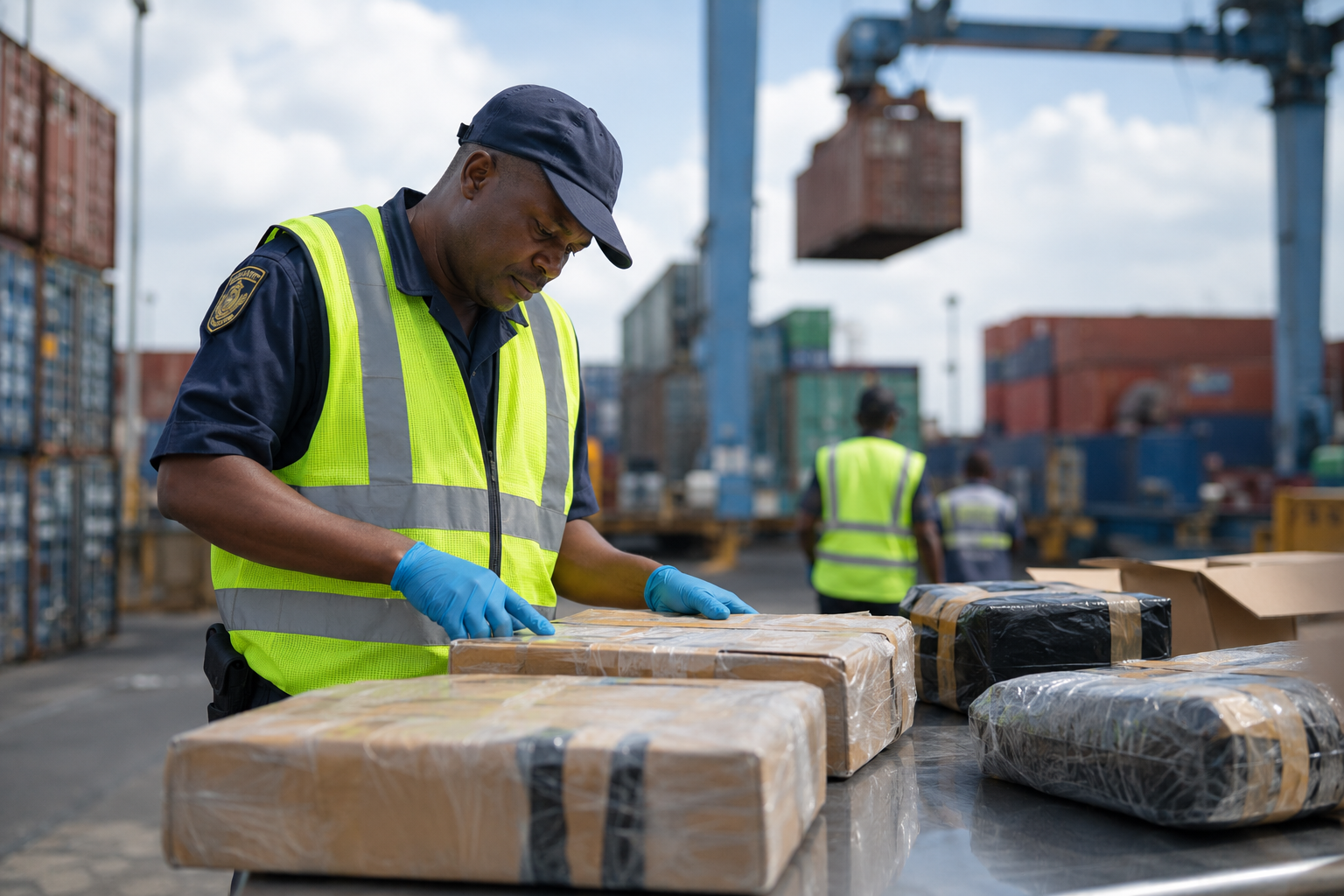
Prohibited and Restricted Imports in South Africa: What You Can and Can’t Bring In
South Africa sorts controlled imports into two groups. Prohibited goods may never be imported. Restricted goods are allowed only with the correct permit or authority in place before they arrive. On top of the law, an air courier has its own list: liquids, aerosols, gels and powders, loose lithium batteries, weapons, food, medicine and supplements cannot fly in a courier parcel at all. This guide covers both lists, the items that most often get turned away, what is too big for a courier, and what to do instead.
In This Guide
- The quick version
- Prohibited vs restricted: what is the difference?
- Goods commonly prohibited
- Goods that need a permit or authority
- What can’t be shipped by air courier?
- The items we turned away most in October
- Too big for a courier: the freight route
- Orders we cannot take, even when the item is legal
- What happens if you get it wrong
- How to check before you buy
- How SSS handles it
- Frequently Asked Questions
The quick version
Most everyday online purchases, such as electronics, clothing, hobby gear and homeware, import without special permits, though duty and VAT still apply. The items that need care fall into a smaller set: anything regulated for safety, health, security or trade-protection reasons, plus anything an aircraft will not carry. If your order touches medicines, supplements, food, cosmetics that can spill, plants, animal products, weapons, batteries, radio equipment or used goods, stop and check before you pay. For how the costs are worked out once an item is cleared to enter, see our guide to how customs value is determined.
Prohibited vs restricted: what is the difference?
The two terms are often used as if they mean the same thing. They do not.
- Prohibited goods cannot be imported under any circumstances. No permit makes them legal.
- Restricted goods can be imported, but only with the correct permit, licence or letter of authority from the relevant South African authority, issued before the shipment arrives.
Several bodies control imports, not only SARS. SARS handles customs clearance, but the permit usually comes from another regulator: ITAC for import permits and used goods, the NRCS for regulated products, ICASA for radio and telecoms equipment, SAHPRA for medicines and health products, and the Department of Agriculture for food, plants and animal products. Knowing which body governs your item is half the battle.
Goods commonly prohibited
The following are generally not allowed into South Africa at all:
- Narcotics and illegal drugs
- Counterfeit and trademark-infringing goods (fake branded clothing, shoes, electronics and accessories)
- Certain weapons, including some knife types and prohibited firearm categories
- Hazardous and toxic waste
- Used and retreaded pneumatic tyres
- Pornographic or obscene material as defined under South African law
This is not an exhaustive list, and definitions matter. When a category is borderline, treat it as prohibited until the controlling authority confirms otherwise.
Goods that need a permit or authority
These can enter the country legally, but only with the right approval in place first.
Firearms and ammunition
Importing firearms requires a permit and the appropriate competency and licensing through the South African Police Service. It is a slow, document-heavy process and not something to start after the goods have shipped.
Medicines, supplements and health products
Medicines and many supplements fall under SAHPRA. Some need registration or a specific authorisation, even for personal use.
Food, plants and animal products
Foodstuffs, seeds, plants and anything of animal origin are controlled by the Department of Agriculture and may need import permits and health certificates. Many are refused outright on biosecurity grounds.
Radio, wireless and telecoms equipment
Devices that transmit, such as two-way radios, signal boosters, some drones and certain smart-home gear, need ICASA type approval.
Regulated electrical and consumer products
Many electrical goods, appliances and certain consumer products need an NRCS Letter of Authority to confirm they meet compulsory safety specifications. Our guide to importing electronics to South Africa covers where this applies.
Used and second-hand goods
Used goods, from clothing to machinery to vehicles, generally need an ITAC import permit. Second-hand vehicle imports in particular are tightly controlled.
If you need a ruling on a specific product, its tariff heading or its permit, ask the controlling authority or a licensed customs broker directly. That answer has to come from them.
What can’t be shipped by air courier?
A legal item is not automatically a shippable one. We move every parcel by express air courier, and airline rules for passenger aircraft are stricter than customs law. These categories cannot go through our standard courier service:
- Liquids, aerosols, gels and powders. Anything that can spill: perfume, liquid make-up, creams, sprays, paint and powdered products.
- Loose lithium batteries and power banks. A battery installed in a device is fine. A spare battery or a power bank is not.
- Weapons and anything associated with weapons. This includes knives, self-defence items such as tasers and pepper spray, toy weapons such as airsoft and paintball, and replica swords.
- Food, medicine and supplements. Anything meant for human or animal consumption needs extra Port Health clearance.
- Alcohol, tobacco and e-cigarettes, including e-cigarette parts and hookah.
- Biological material. If it is or was alive, we cannot move it.
- Hazardous, flammable or explosive materials.
- Certain vehicle parts. Most car spares are fine. Chassis, engine blocks and tyres are not.
The items we turned away most in October
In the two weeks to 25 October, the quote requests we had to decline fell into a few clear groups. None of them were unusual buys. They are the things people reasonably assume will be fine.
Supplements and health products
This was the biggest group by a distance: protein and mass-gainer powders, vitamin capsules, herbal sachets, a kidney supplement for a cat, eye drops and medicated products. They are restricted under South African rules and they are food or medicine for courier purposes, so the answer is no on both counts. Powders are also a spill risk in the air.
Creams and liquid cosmetics
Topical creams, lip treatments and a make-up set that included liquid products. Solid make-up is usually fine. The moment a product is a liquid, gel or cream, it falls under the airline rules above.
Food and drink
Even something as harmless as a large box of tea bags is food, and food needs Port Health clearance that our courier service does not cover.
Knives, weapon parts and lighters
A folding tactical knife, a replacement firing pin for a shotgun, an archery accessory and a fuel lighter with flints. Weapon parts and accessories count as weapons. Lighters and flints count as flammable goods.
These are also among the most common importing mistakes South Africans make, and the cheapest one to avoid is the one you check before you pay.
Too big for a courier: the freight route
Our courier service handles parcels up to 1 m on the longest side and around 30 kg. Over that, the item goes by freight. October’s examples were ordinary purchases that simply did not fit: a set of brake rotors, a sports exhaust system, a 49-inch monitor, a 2.1 m fishing rod, and a bulk case of cleaning supplies with long handles.
Too big is not the same as not allowed. Our freight import service works the same way as courier: we buy from your supplier, arrange the air or sea freight, clear customs and deliver to your address, with duty and VAT in one quote.
Orders we cannot take, even when the item is legal
Some declined requests have nothing to do with the goods. They come from how the purchase is set up.
- Goods you have already bought. We are a purchase-to-delivery service. We do not ship items for third parties or forward goods someone else has paid for.
- Goods already in South Africa. A link to a South African store is a local purchase, not an import.
- Auction-only listings. We need a fixed price to calculate duty and VAT, so the listing needs a Buy It Now price.
- Stores that will not sell to us. Some retailers block foreign cards or will not deliver to our overseas depot. The fix is usually the same item from another seller.
- Delivery outside our area. We deliver within South Africa, and to Harare and Bulawayo in Zimbabwe. We cannot deliver to other countries.
- Screenshots and descriptions. We quote from a direct product link, so we can verify the seller, the price and the specification.
Our FAQ keeps the current list of restrictions and the common reasons we cannot assist.
What happens if you get it wrong
If a restricted item arrives without the required permit, SARS will hold it. Depending on the goods, you may be able to apply for the permit retrospectively (slow, and storage fees accrue while you wait), or the shipment may be seized and destroyed. Prohibited goods are simply confiscated. In all of these cases the seller is unlikely to refund you, so the loss is yours. Honest declarations and correct permits are far cheaper than the alternative.
How to check before you buy
- Identify the category. Is it ingestible, a liquid or powder, battery powered, electrical, wireless, animal or plant based, a weapon or weapon part, or used? Any yes means check further.
- Check the size. Longer than 1 m or heavier than about 30 kg means freight, not courier.
- Find the controlling authority. Match the item to the right body: ITAC, NRCS, ICASA, SAHPRA, SAPS or Agriculture.
- Confirm any permit before paying. Never order first and fix the paperwork later.
- Send the product link before you buy. We tell you at the quote stage whether we can carry it.
For the full process from purchase to delivery, see our step-by-step guide to importing goods to South Africa.
How SSS handles it
Scott’s Shipping Services checks every quote request against the courier restrictions and our service limits before we buy anything. If we cannot carry an item, we tell you at the quote stage, before any money is spent. If the problem is size, or a liquid that can travel by bulk freight, we say so and quote the freight route where it is available. Because we handle the purchase, shipping, customs clearance and delivery as one all-inclusive service, you get one price for the whole journey and no surprise at the border.
Frequently Asked Questions
What items are prohibited from import into South Africa?
Narcotics, counterfeit goods, certain weapons, hazardous waste, used tyres and obscene material are generally prohibited and cannot be imported under any permit. Definitions are specific, so treat a borderline item as prohibited until the controlling authority confirms otherwise.
What is the difference between prohibited and restricted goods?
Prohibited goods can never be imported. Restricted goods can be imported, but only if you hold the correct permit or authority before the shipment arrives. The permit usually comes from a regulator such as ITAC, NRCS, ICASA, SAHPRA, SAPS or the Department of Agriculture, not from SARS.
Can I import supplements, vitamins or protein powder?
Not through our courier service. Supplements and medicines are restricted under South African rules, and anything meant for human or animal consumption needs Port Health clearance that a courier parcel does not get. Powders are also barred from passenger aircraft.
Can you ship perfume, creams or liquid make-up?
No. Liquids, aerosols, gels and powders are prohibited on passenger aircraft, so they cannot travel in a courier parcel. Solid make-up is usually fine. Some liquids can move by bulk freight, so ask if you are buying in quantity.
Can I import electronics with lithium batteries?
Yes, when the battery is installed in the device, such as a phone, laptop or tablet. Loose lithium batteries and power banks cannot be shipped because of the fire risk. Products that transmit a signal may also need ICASA type approval, and certain regulated electrical goods need an NRCS Letter of Authority.
Will SSS tell me before I pay if my item cannot be shipped?
Yes. We check every request at the quote stage. If an item is on the restricted list or outside our courier limits, we tell you before any money is spent, and we suggest freight where it is an option.
If you’re planning your next import, don’t leave it to chance.
Scott’s Shipping Services is here to make the process smooth,
cost-effective, and fully compliant. Get your quick estimate today
using our online calculator,
or contact us for expert advice on your shipment.