International Online Shopping in South Africa: What It Actually Costs

International online shopping gives South Africans access to products, prices, and brands that simply aren’t available locally. The catch is that every purchase from an overseas store attracts import duties, VAT, and shipping costs that aren’t visible at checkout. This guide breaks down what those costs are, where they come from, and how to get a clear total before you commit to a purchase.
In This Guide
- Why international shopping costs are so confusing
- What you actually pay when you import
- How import duties and VAT work
- Which online stores ship to South Africa?
- What about stores that won’t ship here?
- How SSS handles international online shopping
- Common mistakes when shopping from overseas
- FAQ: international online shopping in South Africa
Why international shopping costs are so confusing
When you buy from a South African online store, the price you see is the price you pay. Delivery might add a flat fee, but the total is predictable.
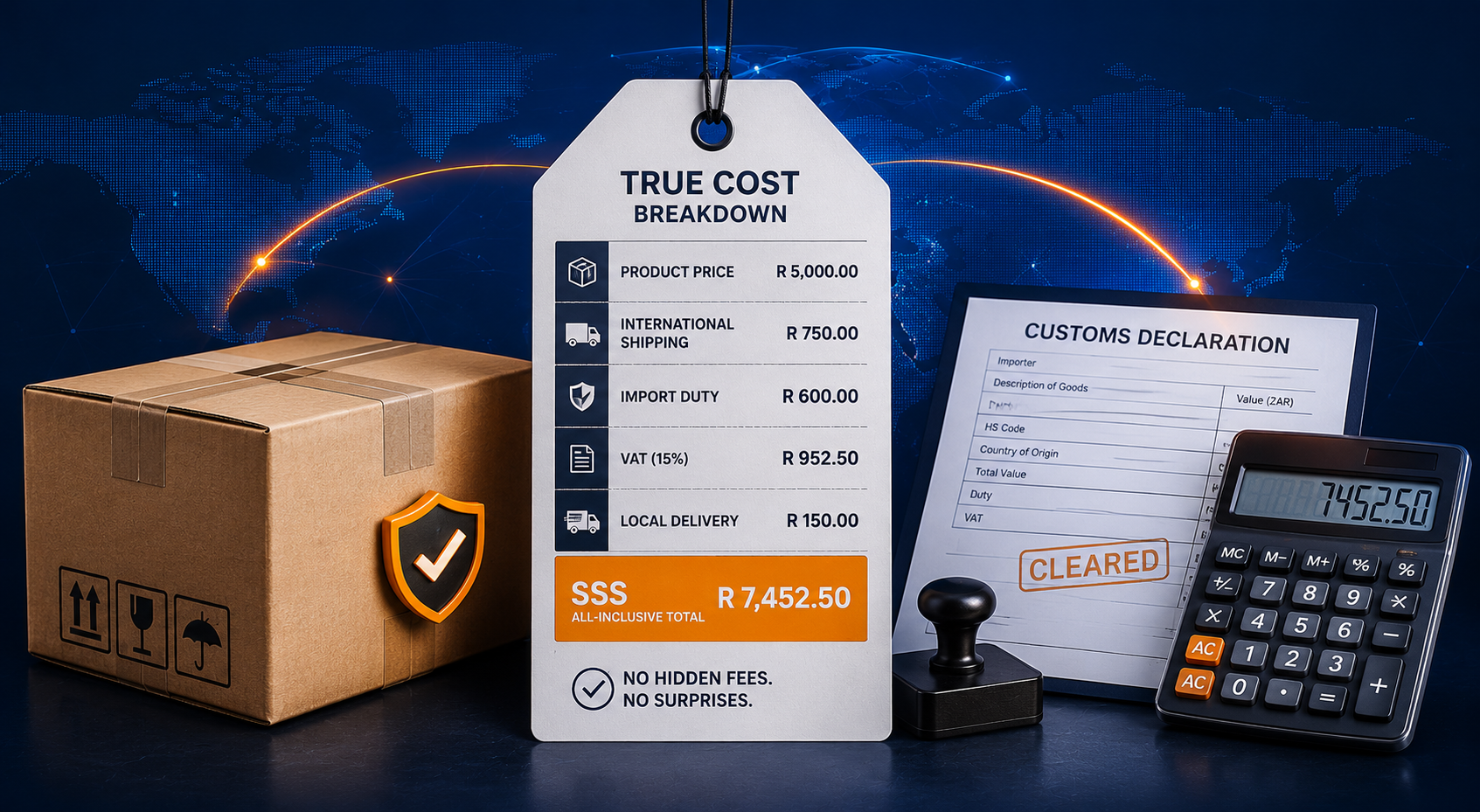
International purchases don’t work that way. The price on the product page is just the starting point. On top of that, you’re looking at international shipping, customs duties, 15% import VAT, and a customs clearance fee. Each of those costs depends on different variables: the product category, the country of origin, the weight, the declared value, and the exchange rate on the day of clearance.
No single online store shows you all of those costs upfront. Some show shipping. None show duties. And the exchange rate you see on Google is not the rate SARS uses to calculate what you owe. That gap between the checkout total and the real landed cost is where most South African buyers get caught off guard.
What you actually pay when you import
Every international online purchase that enters South Africa goes through customs. The total cost of getting that item to your door is made up of these components:
Product price
The cost of the item in the seller’s currency. This gets converted to ZAR at the SARS exchange rate (updated weekly), not the rate shown by your bank or Google.
International shipping
The cost of getting the item from the seller’s warehouse to South Africa. This varies significantly depending on the weight, dimensions, and speed of service. Heavy or bulky items cost more. Express air freight costs more than standard.
Customs duty
A percentage charged by SARS based on the product’s tariff classification. Different products attract different rates. Electronics, clothing, footwear, and food products all fall into different tariff categories with rates ranging from 0% to over 40%. The duty is calculated on the customs value, which includes the product price plus international shipping.
Import VAT (15%)
Charged on the customs value plus the duty amount. This is standard South African VAT, applied to imports the same way it’s applied to local goods. The base it’s calculated on is higher than just the product price because it includes shipping and duty.
Customs clearance fee
A processing fee charged by the clearing agent who submits your customs declaration to SARS. Every shipment entering the country requires this step.
When you add all of these together, the final landed cost of an imported item is typically 30% to 60% above the product’s listed price, depending on the product category. That’s not a reason to avoid international shopping. It’s a reason to know the number before you buy. For a full breakdown of how SARS arrives at the taxable value, see our guide on how customs value is determined.
How import duties and VAT work
Import duty is not a flat rate. Every product that exists has a corresponding tariff code (called an HS code) in the SARS tariff book. That code determines the duty percentage. A pair of running shoes, a laptop, and a kitchen mixer all attract different rates.
This is where most online “import calculators” fall short. They either ask you to look up your own tariff code (which requires specialist knowledge) or they apply a flat estimate that may be wildly off.
VAT is simpler: it’s 15%, applied after duty has been added. But because it’s calculated on the customs value plus duty (not just the product price), the actual rand amount is higher than most people expect.
The numbers shift with every product category, exchange rate, and shipping method. The only way to get an accurate figure for a specific item is to have it properly classified and costed. That’s what SSS does when you request an estimate.
Which online stores ship to South Africa?
Some international retailers ship directly to South Africa. The experience varies. A few examples:
Amazon (US, UK, DE): Ships selected items to South Africa. Not all products are eligible, and Amazon’s international shipping fees can be steep on heavier items. Amazon does collect estimated import duties at checkout on some orders, but the estimate is not always accurate, and reconciliation can be slow. For a detailed look, see our Amazon South Africa guide.
eBay: Whether an item ships to South Africa depends entirely on the individual seller. Many don’t. Those who do often charge high shipping or use slow, untracked methods. Our eBay South Africa guide covers how to navigate this.
AliExpress: Ships most items to South Africa, usually via China Post or similar economy services. Shipping is often listed as free, but delivery times are long (20 to 60 days) and tracking can drop off once the parcel enters the South African postal system. For a detailed look at buying from AliExpress, see our AliExpress South Africa guide.
Etsy: Shipping availability varies by seller. Many Etsy sellers are small operations and don’t offer international shipping at all. Those who do may not be familiar with customs declarations, which can cause delays. We cover this in detail in our Etsy buying guide.
For a broader list of trusted international stores, see our reputable online retailers guide.
What about stores that won’t ship here?
Many of the most popular international retailers don’t ship to South Africa at all. US stores in particular often restrict international delivery, or limit it to a handful of countries that don’t include South Africa.
This is one of the main reasons SSS exists. When you request a quote through SSS, you don’t need the store to ship internationally. SSS purchases the item on your behalf, receives it at a US or international warehouse, and then ships it to South Africa with full customs clearance included. The store only needs to ship domestically within its own country.
This opens up retailers that would otherwise be inaccessible. If you can find it online and link to it, SSS can quote it. For more on imports from the US specifically, see our USA import guide.
How SSS handles international online shopping
Scott’s Shipping Services provides end-to-end importing. That means we handle the purchase, international shipping, customs clearance, duties, VAT, and delivery to your door, quoted as one all-inclusive price before you commit.
Here’s how the process works:
1. You find what you want. Browse any online store, anywhere. Copy the product link or describe what you’re looking for.
2. You get a total cost upfront. Use the Quick Estimate calculator for an instant ballpark, or submit a full quote request for exact pricing. The quote includes everything: product price, shipping, duties, VAT, clearance. One number.
3. SSS handles the rest. Once you approve the quote, SSS purchases the item, manages international shipping, submits the customs declaration, pays the duties and VAT on your behalf, and arranges delivery to your door.
You don’t need to deal with customs brokers, tariff codes, SARS, or surprise charges at the door. The price you agree to is the price you pay. For a full walkthrough of each step, see our step-by-step import guide.
Common mistakes when shopping from overseas
Assuming the checkout price is the final price
It never is. Even if the store charges for international shipping at checkout, customs duties and VAT are still added when the parcel arrives in South Africa. Some couriers collect this at delivery. Others hold the parcel until you pay.
Using the Google exchange rate to estimate costs
SARS uses its own weekly exchange rate for customs calculations. Your bank uses a different rate again (plus a conversion fee). The price in rands at checkout, the SARS valuation, and the amount debited from your account can all be different numbers.
Buying from unfamiliar stores without checking legitimacy
Not every online store is what it appears to be. Scam sites often mimic real retailers with near-identical layouts and too-good-to-be-true pricing. Before handing over payment details, check the store’s reputation. Our reputable retailers guide covers what to look for.
Ordering restricted or prohibited items
South Africa restricts or prohibits the import of certain goods, including specific food products, medications, weapons, and counterfeit goods. If an item is seized at customs, you lose both the item and the money. Check before you buy.
For a deeper dive into these and other pitfalls, read our guide on common importing mistakes and hidden shipping costs.
FAQ: international online shopping in South Africa
Do I pay import duty on every international purchase?
Yes. Every commercial import into South Africa is subject to customs duty and 15% import VAT. The duty rate depends on the product’s tariff classification. Some categories attract 0% duty, but VAT always applies.
How long does international shipping to South Africa take?
It depends on the origin country, shipping method, and customs processing time. Express courier shipments from the US or UK typically take 5 to 10 business days. Economy options from China can take 20 to 60 days. Customs clearance adds 1 to 3 business days on top of transit time.
Can I buy from a store that doesn’t ship to South Africa?
Yes, through a service like SSS. We purchase the item on your behalf, receive it at a warehouse in the seller’s country, and ship it to South Africa with full customs clearance. The store only needs to deliver domestically.
Is it cheaper to buy internationally or locally?
It depends on the product. Some items are significantly cheaper overseas even after duties and shipping, especially electronics, speciality equipment, and brands not sold in South Africa. Others are cheaper locally once you factor in import costs. The only way to know is to compare the landed cost (not the shelf price) against the local price. Use the Quick Estimate calculator to check.
What happens if my imported item is damaged or wrong?
Returns on international purchases are complicated and often expensive. The original store’s return policy may not cover international shipping costs, and you may face a second round of customs and shipping fees to send the item back. This is one of the practical advantages of using SSS: we manage the purchasing relationship with the seller on your behalf.
Planning your next import? Use our online calculator for a quick estimate, or get in touch for advice on your shipment.