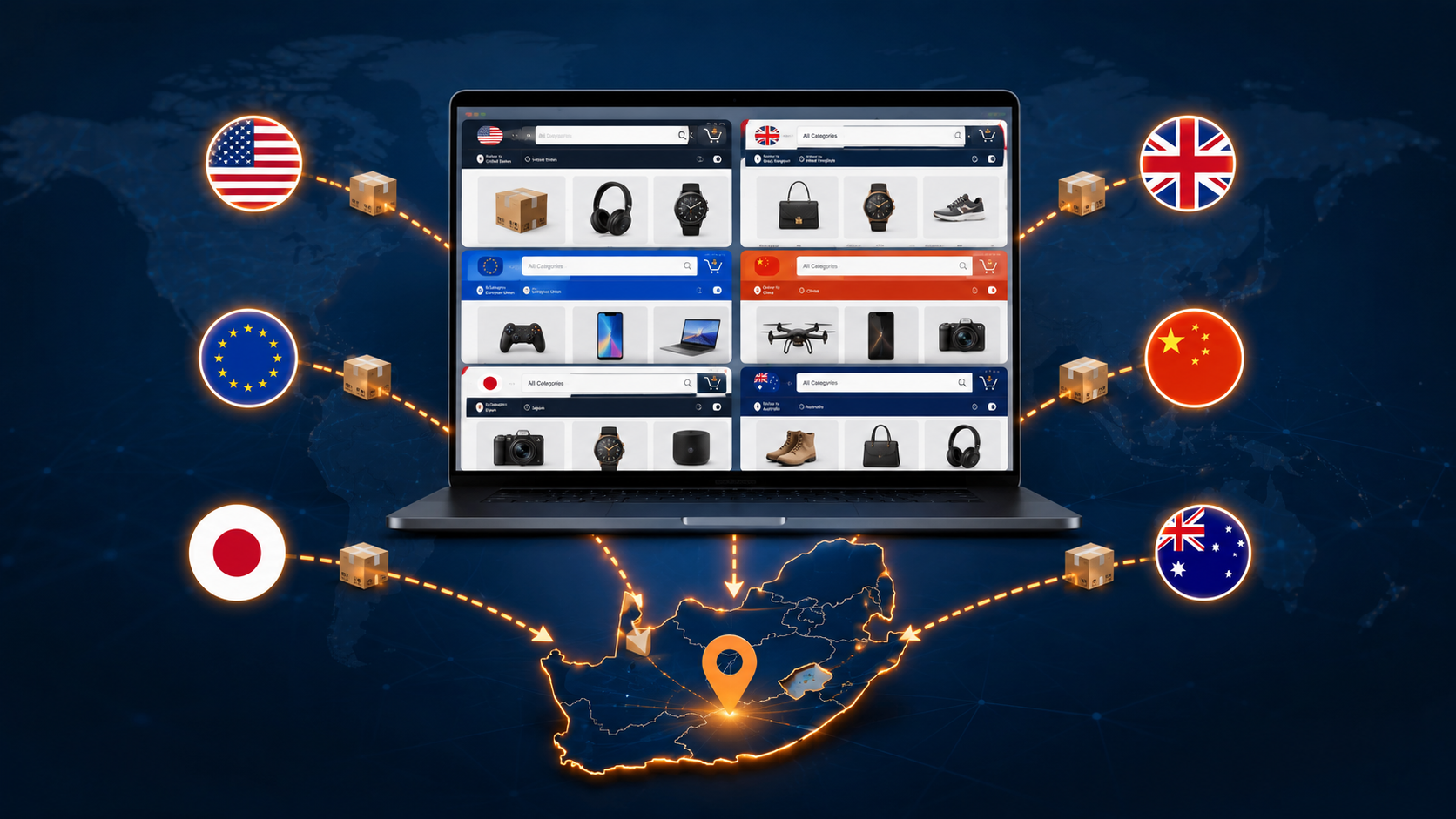
International Online Shopping: A Guide for South Africans

Buying from overseas retailers is one of the fastest ways to get products that are overpriced, unavailable, or simply not sold in South Africa. The catch: shipping costs, customs duties, and VAT can turn a good deal into an expensive lesson. This guide covers what you actually need to know before placing an international order, and how to avoid the common traps.
In This Guide
- Why South Africans shop internationally
- What international shopping actually costs
- Customs duties and VAT explained
- Where to shop: trusted international retailers
- What you can’t import into South Africa
- Doing it yourself vs using an import service
- How Scott’s Shipping Services works
- Tips for first-time international shoppers
- Frequently asked questions
Why South Africans shop internationally
The reasons are practical. Some products simply aren’t available from South African retailers. Others are, but at a markup that makes importing the better option even after shipping and duties.
Electronics are a good example. A laptop that retails for R25,000 locally might cost the equivalent of R16,000 on Amazon US. Even after shipping, customs duty, and 15% VAT, the total landed cost can still come in well below the local price. The same applies to specialised tools, auto parts, supplements, clothing from specific brands, and niche hobby equipment.
South Africa’s consumer market is relatively small by global standards. International retailers carry ranges that local shops never will, and in many categories the pricing gap is significant enough to justify the effort of importing.
What international shopping actually costs
The purchase price is only part of the picture. The real cost of an international order is the landed cost: the total you pay to have the item in your hands, in South Africa. For a detailed breakdown of how these costs add up, see our guide to what international online shopping actually costs.
Landed cost includes:
- Product price in the original currency, converted to ZAR
- International shipping, which varies by weight, dimensions, and origin country
- Customs duty, calculated as a percentage of the declared customs value (product price + shipping + insurance)
- 15% VAT, charged on the customs value plus the duty amount
- Clearance fees, charged by the clearing agent who processes your goods through SARS
A common mistake is budgeting only for the product and shipping, then getting hit with an unexpected customs bill. The customs value calculation is something worth understanding before you buy. It is also one of the most common importing mistakes South Africans make.
Customs duties and VAT explained
Every item imported into South Africa is classified under a tariff code in the Harmonised System (HS). That code determines the duty rate, which can range from 0% to over 40% depending on the product category.
How duty is calculated
SARS calculates duty on the customs value, which is the FOB (Free on Board) price of the goods plus the cost of freight and insurance to the South African port of entry. The duty rate for your item’s HS code is applied to that value.
How VAT is calculated
VAT at 15% is then charged on the customs value plus the duty amount. So if your customs value is R10,000 and duty is R2,000, you pay VAT on R12,000, which comes to R1,800.
De minimis threshold
South Africa does not have a meaningful de minimis threshold for customs duties. Unlike some countries where low-value imports enter duty-free, SARS can and does assess duties on shipments of any value. Budget accordingly.
Where to shop: trusted international retailers
Choosing the right retailer matters. Buyer protection, reliable dispatch, and accurate product listings make a real difference when you’re shopping across borders.
These are some of the most commonly used international retailers by South African shoppers:
- Amazon (US, UK, DE): Wide product range, reliable dispatch, good returns policy. Amazon US is the most popular origin for South African imports. Read our full guide to buying from Amazon in South Africa.
- eBay: Useful for hard-to-find items, collectibles, and used goods. Buyer protection applies on most listings. See our eBay South Africa guide.
- AliExpress: Low prices on a huge range. Longer shipping times from China. Read our AliExpress guide for South Africans before ordering.
- B&H Photo Video: Specialist electronics and camera gear. Competitive pricing and accurate descriptions.
We’ve also put together a broader list of reputable international online retailers if you’re looking for more options.
What you can’t import into South Africa
South Africa restricts or prohibits the import of certain goods. Getting this wrong can result in your shipment being seized at the border, with no refund from the retailer.
Common restricted categories include:
- Certain foodstuffs and supplements (SAHPRA and DAFF regulations)
- Weapons and weapon components, including some knives
- Counterfeit or trademark-infringing goods
- Certain electronics that don’t meet NRCS standards
- Hazardous materials and chemicals
If you’re unsure about a specific product, ask before you buy. SSS reviews every order before purchase and will flag any compliance issues upfront.
Doing it yourself vs using an import service
You can absolutely handle an international purchase on your own. Many South Africans do, especially for low-value items shipped via postal services. But the experience changes depending on the value and complexity of what you’re importing.
When DIY works
For small, low-value items under a few hundred rand, ordering direct and having it shipped via the postal system is usually fine. Delivery takes longer, tracking is limited, and you may still get a customs bill, but the process is straightforward enough.
When a service makes sense
For higher-value purchases, bulk orders, or anything where you need certainty on cost and timing, using an import service removes the guesswork. You get a single all-inclusive price upfront: product, shipping, duties, VAT, clearance, and delivery. No surprises at the door. Read more about the benefits of using an import company.
This is especially relevant if you’re importing goods for a business, where accurate cost forecasting and proper customs documentation matter.
How Scott’s Shipping Services works
SSS is a South African import logistics company. We handle end-to-end importing: we purchase the item on your behalf, ship it internationally, clear it through customs, pay the duties and VAT, and deliver it to your door. You get one quote that covers everything.
Here’s the process:
- Send us a link to the product you want, or describe what you’re looking for.
- We quote a single all-inclusive price covering the product, international shipping, customs duty, VAT, clearance, and local delivery.
- You approve, we purchase and ship.
- We clear customs and handle all SARS paperwork.
- We deliver to your door anywhere in South Africa.
No hidden fees. No customs bill waiting at the door. The price we quote is the price you pay. For a detailed walkthrough, see our step-by-step guide to importing.
We offer three import tiers depending on what you need:
- Courier imports for standard international purchases
- Cargo and freight for larger or heavier shipments
- Concierge imports for hard-to-source items or purchases from retailers that don’t ship internationally
Tips for first-time international shoppers
1. Calculate the full landed cost before you buy
Don’t just compare the product price. Add shipping, duty, and VAT. A “cheap” product overseas can end up costing more than buying locally once all costs are included.
2. Pay in the retailer’s currency
If given the option, pay in USD, GBP, or EUR rather than accepting a conversion to ZAR at checkout. Retailer currency conversions are almost always worse than your bank’s rate.
3. Check what you’re actually allowed to import
A seized shipment means you lose the product and the money. Five minutes checking restricted items can save you thousands.
4. Keep your proof of purchase
SARS can request an invoice at any time during clearance. If you can’t produce one, they’ll assign their own value, which is rarely in your favour.
5. Understand delivery timescales
International courier shipments typically take 5 to 10 business days. Sea freight takes 4 to 8 weeks. Postal services are unpredictable. Build realistic timelines, especially if you need the item by a specific date.
6. Use a reputable retailer
Stick to established platforms with buyer protection. If a deal looks too good to be true, it usually is. Our trusted retailers list is a good starting point.
Frequently asked questions
Do I have to pay customs duty on everything I import?
In most cases, yes. South Africa does not have a meaningful duty-free threshold for imported goods. SARS assesses duties based on the item’s tariff classification and declared customs value.
How much does it cost to import something from the USA to South Africa?
It depends on the product, weight, and dimensions. As a rough guide: expect to pay the product price, plus international shipping (from around R500 for small items), plus customs duty (0% to 45% depending on the item), plus 15% VAT on the total. For an exact number, request a quick estimate. For a full breakdown of USA imports specifically, see our guide to importing from the USA.
Can I buy from Amazon and have it delivered to South Africa?
Amazon ships some items directly to South Africa, but many products are restricted or unavailable for international delivery. Using an import service gives you access to the full Amazon catalogue, not just the items flagged for SA delivery. See our Amazon South Africa guide for the full details.
What happens if my package gets stuck in customs?
Customs delays usually happen because of missing or incorrect documentation, or because SARS needs to verify the declared value. When SSS handles your import, we manage all customs paperwork and follow up directly with SARS if there’s a query.
Is it cheaper to import or buy locally?
It depends on the product. Electronics, specialised equipment, and niche items are often significantly cheaper to import even after duties and shipping. Common consumer goods with strong local distribution are usually cheaper to buy in South Africa. Calculate the landed cost before deciding.
Does Scott’s Shipping Services handle the purchase as well?
Yes. SSS is an end-to-end import service. We purchase the item on your behalf, ship it internationally, clear it through customs, and deliver it to your door. You don’t need to buy the product yourself first.
If you’re planning your next import, don’t leave it to chance.
Scott’s Shipping Services is here to make the process smooth,
cost-effective, and fully compliant. Get your quick estimate today
using our online calculator,
or contact us for expert advice on your shipment.