

Importing from the UK to South Africa: Costs, VAT and How It Works

The UK is one of the easier countries for South Africans to buy from. The mains voltage matches ours, the retailers are straightforward about shipping, and in several categories the range is far deeper than anything sold locally. What catches people out is tax on both ends: 20% UK VAT sitting inside the shelf price, then SARS duty and VAT on arrival. This guide covers what you will actually pay, in what order, and where the savings genuinely are rather than where people assume they are.
In This Guide
The short version
A UK import has three costs, and only one of them is the price on the website.
- The goods. The shelf price, with 20% UK VAT included. For almost every consumer import that VAT stays on, for reasons worth understanding before you budget.
- The freight. Courier for anything small and valuable, air or sea freight once weight and volume climb.
- The customs charges. Import duty set by the product’s tariff code, then 15% VAT calculated on the customs value plus a 10% uplift plus that duty.
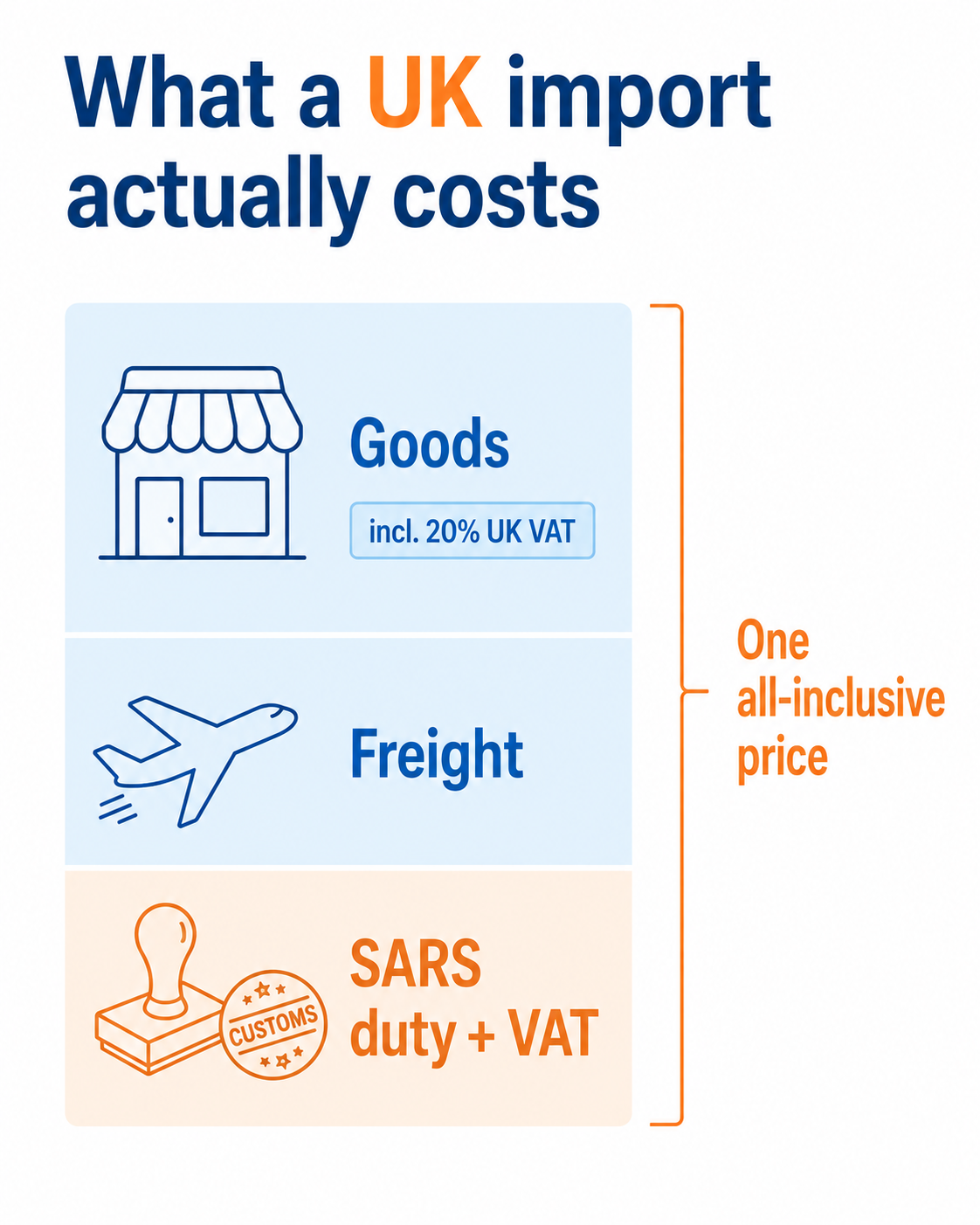
Get all three quoted together, up front, before you commit. Getting a good price on the first and discovering the third at your front door is the single most common way a UK bargain stops being one.
UK VAT: budget for the 20%
You will read online that UK VAT does not apply to exports and that South African buyers should be getting 20% off. The principle is real. The practice, for almost every consumer import, is not. It is worth understanding why, so you budget on the right number.
UK VAT is 20% and it is built into the price on a British retail website. VAT is a tax on consumption in the UK, so goods genuinely being exported are zero rated. That much is true.
Zero rating comes with conditions. The goods must actually leave the UK, and the retailer has to obtain and keep documentary evidence of the export within a set period. That is a real administrative obligation sitting on the seller, not a box the buyer ticks. Two things stop it applying to normal consumer purchases:
Consolidation through a UK address. Almost every import service, ours included, has UK purchases delivered to a UK depot, where they are consolidated and prepared for onward shipping. As far as the retailer is concerned that is a domestic UK sale to a UK address, so the 20% stays on. This is what makes reliable tracking, consolidation of multiple orders and proper packing possible, and it is the trade-off that comes with it.
Retailer willingness. Even where a direct export is possible, most consumer retailers will not take on the export evidence obligations for a single order. The ones that will are generally selling at commercial volume to trade buyers.
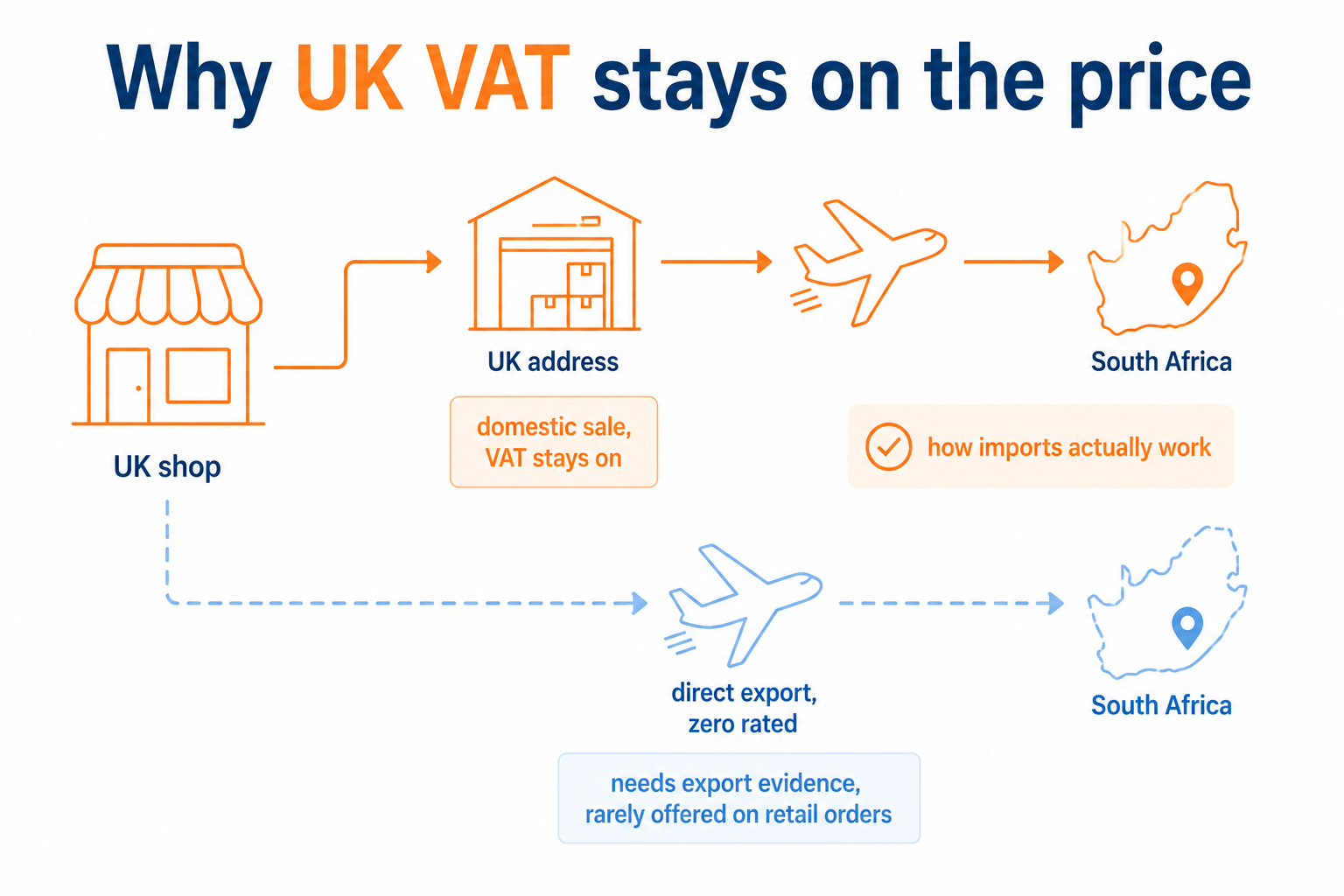
Straight answer on our own service. We consolidate through a UK address, so the 20% UK VAT is included in the price we quote you. We would rather say that plainly than let you expect a saving that never materialises. If a service tells you it can strip UK VAT off a one-off retail purchase, ask exactly how, and ask before you pay.
Where zero rating does come into play is business-to-business buying at volume, from a supplier already set up to export and issue the paperwork. If you are importing commercially and repeatedly, it is worth raising with your supplier directly.
One further point, because it affects the sums. The customs value SARS works from is based on what you actually paid for the goods, so anything sitting inside that price travels with it. That is the practical argument for comparing the landed price against local retail rather than comparing the UK shelf price against local retail. Even with the VAT in it, UK pricing still beats South African retail in plenty of categories. It just does not beat it by as much as the shelf price suggests.
What SARS charges when it lands
South African import charges are calculated in a fixed order, and knowing the order is what lets you predict the number rather than discover it.
Step one: the customs value. SARS establishes what the goods are worth, normally on an FOB basis, using the transaction value on your commercial invoice. This is the foundation for everything that follows, which is why a vague or under-declared invoice causes so much trouble. We cover the mechanics in how customs value is determined in South Africa.
Step two: customs duty. The rate is set by the product’s tariff heading and ranges from 0% to 45%. This is where categories diverge sharply. Most consumer electronics, laptops, phones and computer parts carry no duty at all. Clothing, footwear and textiles sit at the top of the range. Two parcels of identical value can attract wildly different duty depending purely on what is inside them.
Step three: VAT at 15%. Import VAT is not charged on the customs value. It is charged on the Added Tax Value, which is the customs value, plus a 10% uplift, plus any duty already levied. The uplift catches people out because it means the effective VAT on a duty-free item is a little over 16.5% of the customs value rather than 15%.
| Step | Calculation |
|---|---|
| Customs value | Transaction value of the goods, normally FOB |
| Duty | Customs value x the rate for that tariff heading (0% to 45%) |
| Added Tax Value | Customs value + 10% of customs value + duty |
| VAT | Added Tax Value x 15% |
Before you buy, check that the item is not restricted. Some categories need a permit or authority in place before the goods arrive, and sorting that out afterwards is expensive. Our guide to prohibited and restricted imports in South Africa covers what falls where.
Buying in the UK does not lower your duty
This comes up constantly, usually because someone has read that South Africa has an arrangement with the UK. It is worth settling before you build it into a budget, because it will not survive contact with a customs entry.
South African import duty is decided by two things: the tariff heading your goods classify under, and the customs value SARS establishes. Where you happened to buy the item changes neither, and across the UK shipments we have handled, cargo clears at the general rates.
There is a second reason it matters less than people fear: the categories South Africans import most from Britain, meaning electronics, computers and phones, carry no customs duty at all. A discount on top of zero changes nothing.
Budget on the general rate. Cost your import on the general rate for your tariff heading. If a supplier or a forwarder has told you otherwise, ask them to put the rate and the reasoning in writing before you commit any money, because the entry is filed in your name and the shortfall is billed to you if it turns out to be wrong.
What South Africans actually buy from the UK
The UK earns its place for a few specific reasons rather than being cheapest across the board.
Brands that do not sell here. British clothing, outdoor and heritage brands with no South African distribution at all, where importing is the only route rather than the cheaper one.
Car parts. A deep specialist market for European and British marques, often with parts that local suppliers either cannot get or price as though they are rare.
Audio and hi-fi. The UK has a serious audio retail scene and a strong second-hand market. Worth pairing with our guide to importing audio equipment into South Africa.
Tools, garden and home equipment. Categories where the local range is thin and the overseas selection is not.
Books, hobby and specialist gear. Model kits, brewing equipment, craft supplies, sporting goods. Small, high value to weight, and often simply unavailable locally.
Where the UK usually does not win is mainstream consumer electronics, where the United States is typically better priced. If that is what you are after, see importing from the USA to South Africa instead.
Plugs, sizing and the things that catch people out
Voltage is not a problem. This is the UK’s quiet advantage. Both countries run 230V at 50Hz, so British appliances and electronics work here exactly as they do there. No transformer, no stepped-down power supply, none of the hassle that comes with 120V equipment from the United States. You need a plug adapter, or a replacement cable, and that is the whole of it.
Sizing is not standard. UK clothing sizes are close to South African ones but not identical, and UK shoe sizes differ from both US and EU scales. Check the retailer’s own size chart rather than converting in your head, because returns from South Africa are rarely worth the freight.
Warranties usually stop at the border. Most UK retail warranties are valid in the UK only. Some manufacturers honour international warranties on premium goods, many do not. Assume no local support unless the manufacturer says otherwise in writing.
Region locking still exists. Less than it used to, but Blu-rays, some game hardware and certain subscription-bound devices still carry regional restrictions. Worth thirty seconds of checking.
Watch the freight method. A single small parcel goes by courier without much thought. Once you are over about 30kg or the box gets bulky, the air versus sea decision starts to dominate the cost, and it is worth making deliberately. We break it down in air freight vs sea freight to South Africa.
Freight changes the tax position too. Everything above assumes a courier purchase, where the 20% UK VAT stays on the price. On a freight-sized order shipped direct to port as a documented export, it comes off. If what you are buying is machinery, workshop equipment or anything over about 30 kg, read freight from the UK and Europe to South Africa before you commit to either route, because the same item can land at meaningfully different costs depending on how the purchase is structured.
How SSS handles a UK import
Scott’s Shipping Services is an end-to-end import service, which means we buy the goods as well as move them.
You send us a link to what you want. We price the whole thing as one number: the goods, the freight, the duty, the VAT, the clearing and the delivery to your door. You approve it, we buy it, and the price does not move. There is no second invoice when it arrives, and no courier holding your parcel hostage for a charge nobody mentioned.
The part that saves the most trouble is classification. We work out the tariff heading and the landed cost before anything ships, rather than discovering a problem once the goods are sitting at a depot accruing storage. Buying on your behalf also means we deal with the UK retailer directly, so a seller that will not ship to South Africa is not an obstacle, and multiple orders can be consolidated into one shipment instead of paying freight and clearing on each.
What we do not do: clear goods you have already bought, or handle shipments someone else arranged. The all-inclusive price only works when we control the whole chain. If you want us to buy specific items on your behalf, that is our international shopping concierge. If you are new to this entirely, start with how to import goods to South Africa.
Living in the UK and buying for family in Zimbabwe? We buy from UK stores and deliver to the door in Harare and Bulawayo. See UK shopping delivered to Zimbabwe.
Frequently asked questions
Can I get UK VAT off my purchase?
Usually not, on a normal consumer purchase. UK exports are zero rated in principle, but only where the goods leave the UK and the retailer obtains and keeps documentary evidence of the export. Import services consolidate through a UK address, which makes the sale a domestic one and keeps the 20% on, and most consumer retailers will not take on the export paperwork for a single order in any case. Budget on the shelf price including VAT. Zero rating is realistic for commercial buying at volume from a supplier set up to export.
How much duty and VAT will I pay bringing goods from the UK into South Africa?
Customs duty is set by the product’s tariff heading and ranges from 0% to 45%. Most consumer electronics carry no duty, while clothing and textiles sit at the high end. VAT of 15% is then charged on the Added Tax Value, which is the customs value plus a 10% uplift plus any duty. On a duty-free item, the effective VAT works out just over 16.5% of the customs value.
Will I get a lower rate of duty because I am buying from the UK?
No. Duty is decided by the tariff heading your goods classify under and the customs value SARS establishes, not by where you bought them, and rates run from 0% to 45%. Across the UK shipments we have handled, cargo clears at the general rates. It matters less than people fear in any case, because the categories South Africans import most from Britain, meaning electronics, computers and phones, carry no duty at all. Budget on the general rate for your heading.
Will UK appliances and electronics work in South Africa?
Yes. Both countries run 230V at 50Hz, so UK equipment works here directly. You need a plug adapter or a replacement cable, but no voltage transformer. This is a real advantage over importing from the United States, which runs on 120V.
How long does shipping from the UK to South Africa take?
Courier shipments typically move in days rather than weeks once collected. Air freight is longer, and sea freight is measured in weeks and only makes sense on heavy or bulky consignments. The variable is rarely the flight, it is documentation and clearing, which is why getting the paperwork right before the goods move is the thing that actually saves time.
Useful resources
SSS: How to import goods to South Africa
SSS: How customs value is determined in South Africa
SSS: Prohibited and restricted imports in South Africa
SSS: Importing from the USA to South Africa
SSS: Five importing mistakes that cost South Africans money

Found something in the UK? Use our online calculator for a quick estimate, or get in touch and we will land it for you.