Local LLMs for Professional Firms in South Africa: POPIA, Data Control and Audit
For a South African firm handling client money, medical records or legal files, the question with AI is not which model is cleverest. It is where your data goes. A local LLM, one that runs on hardware you own, keeps that data in the building, which is the cleanest answer to POPIA. This guide is for financial, medical and legal practices weighing AI against their compliance obligations.
To be clear on what we do: Scott’s Shipping Services does not sell the software. We import the hardware a local setup runs on, cleared and delivered, so the estimate below is for that import.
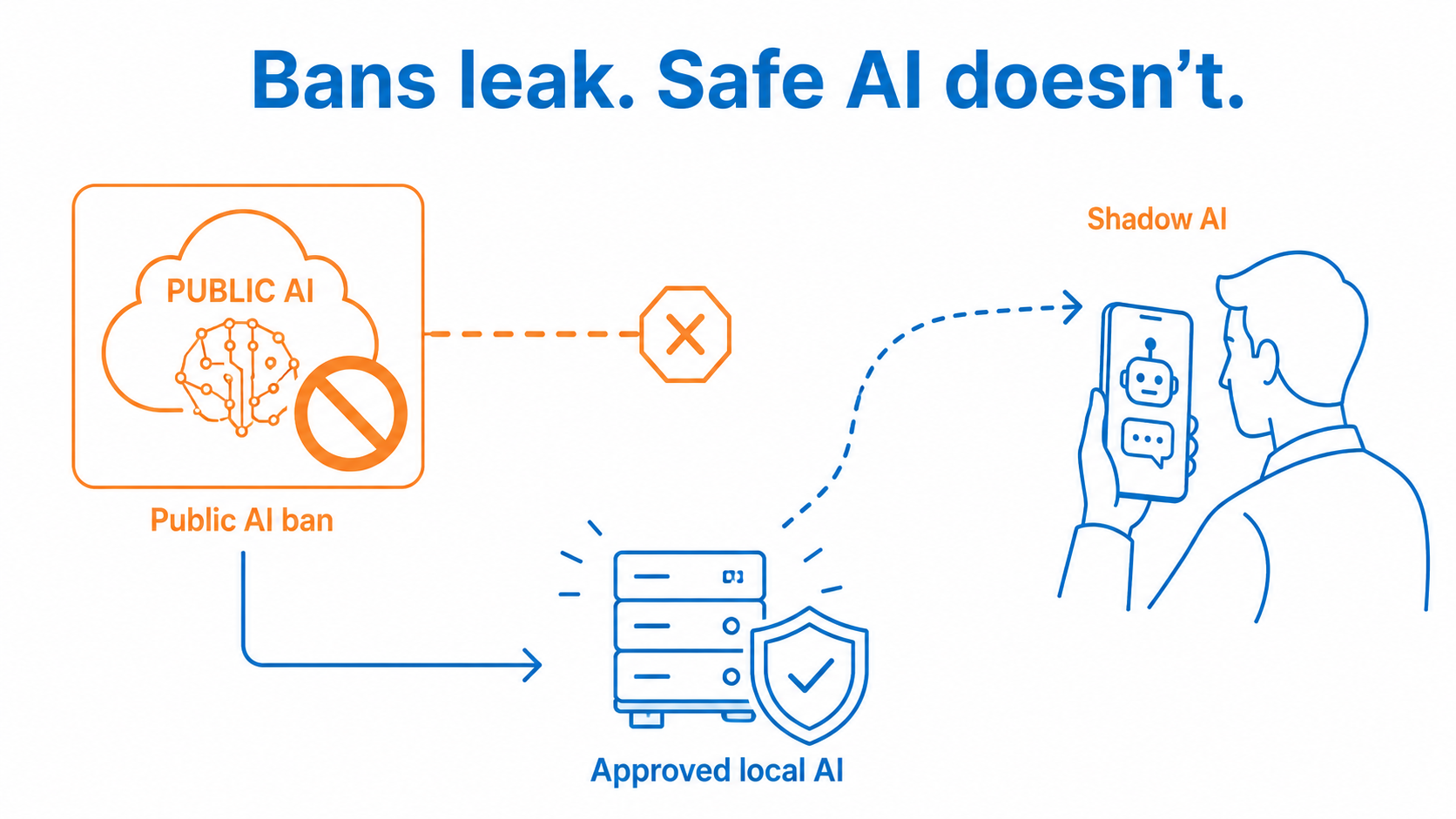
If your staff have deadlines and a phone, some of them are already pasting work into a public AI tool. Often that work contains client information. The common response is to block the public tools on the office network.
Blocks rarely hold. People switch to a personal phone or a home laptop, and the data leaves anyway, now with no oversight at all. A ban tends to push the problem underground rather than solve it. Giving staff a safe, sanctioned AI they are allowed to use is more effective than an unenforceable rule. A local model is that safe option, because the data stays inside your control.
Why cloud privacy promises may fall short of POPIA
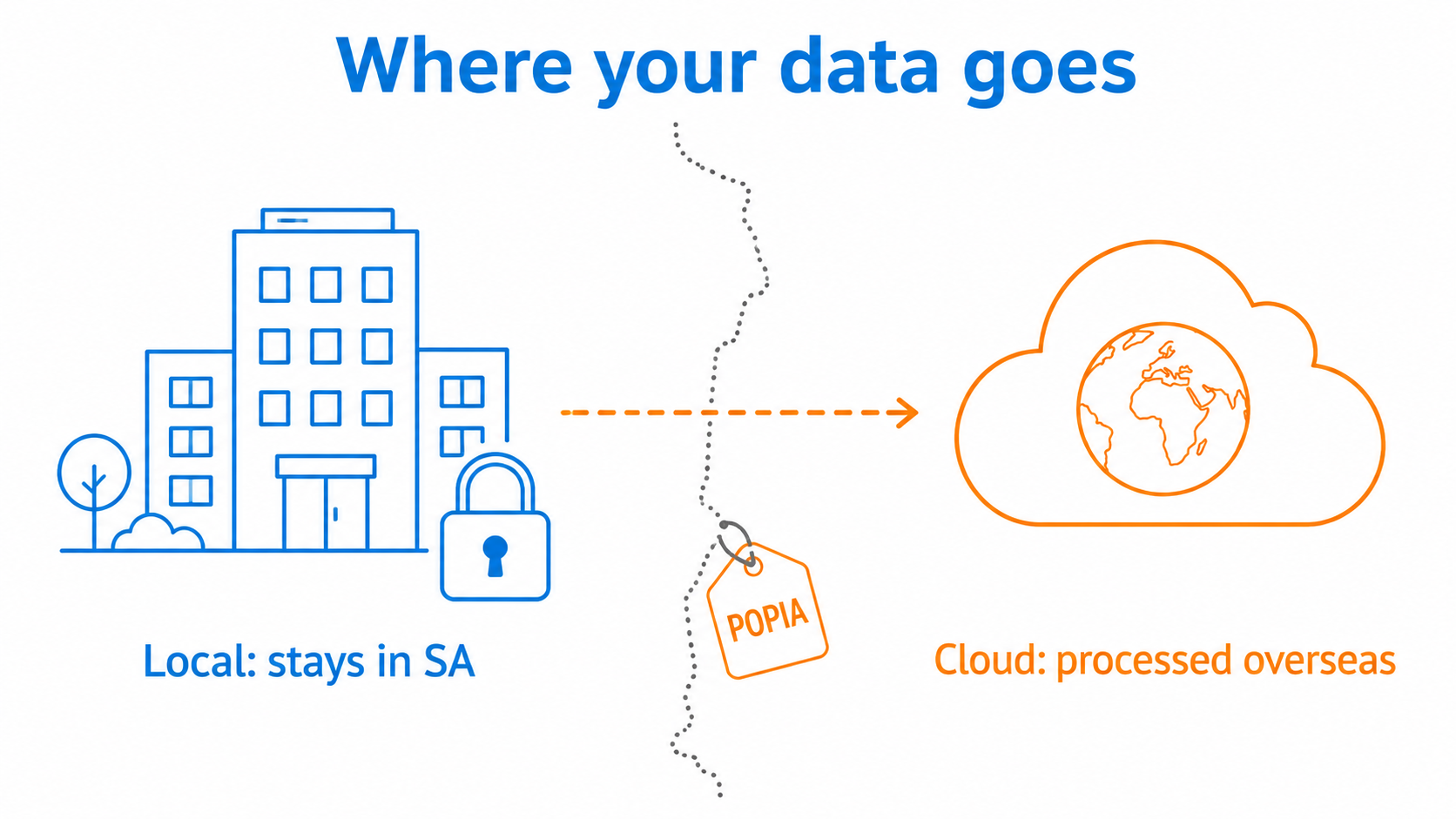
POPIA governs how personal information is processed, including when it is sent across borders. The major AI providers are built around large-scale processing, much of it on overseas infrastructure. A professional or API plan still routes your prompts, and whatever you paste into them, to a processor outside South Africa.
A provider can offer a genuine privacy policy and still not line up neatly with what POPIA asks of you as the responsible party. The strongest data-residency and processing controls are usually reserved for large enterprise agreements, not the plans a typical firm signs up for. Running the model locally sidesteps the cross-border question entirely, because the data never leaves your premises.
This is general information, not legal advice. Where the line sits for your practice is a question for a compliance specialist, but the structural point holds: on-premises is the simplest position to defend.
You can audit a local model
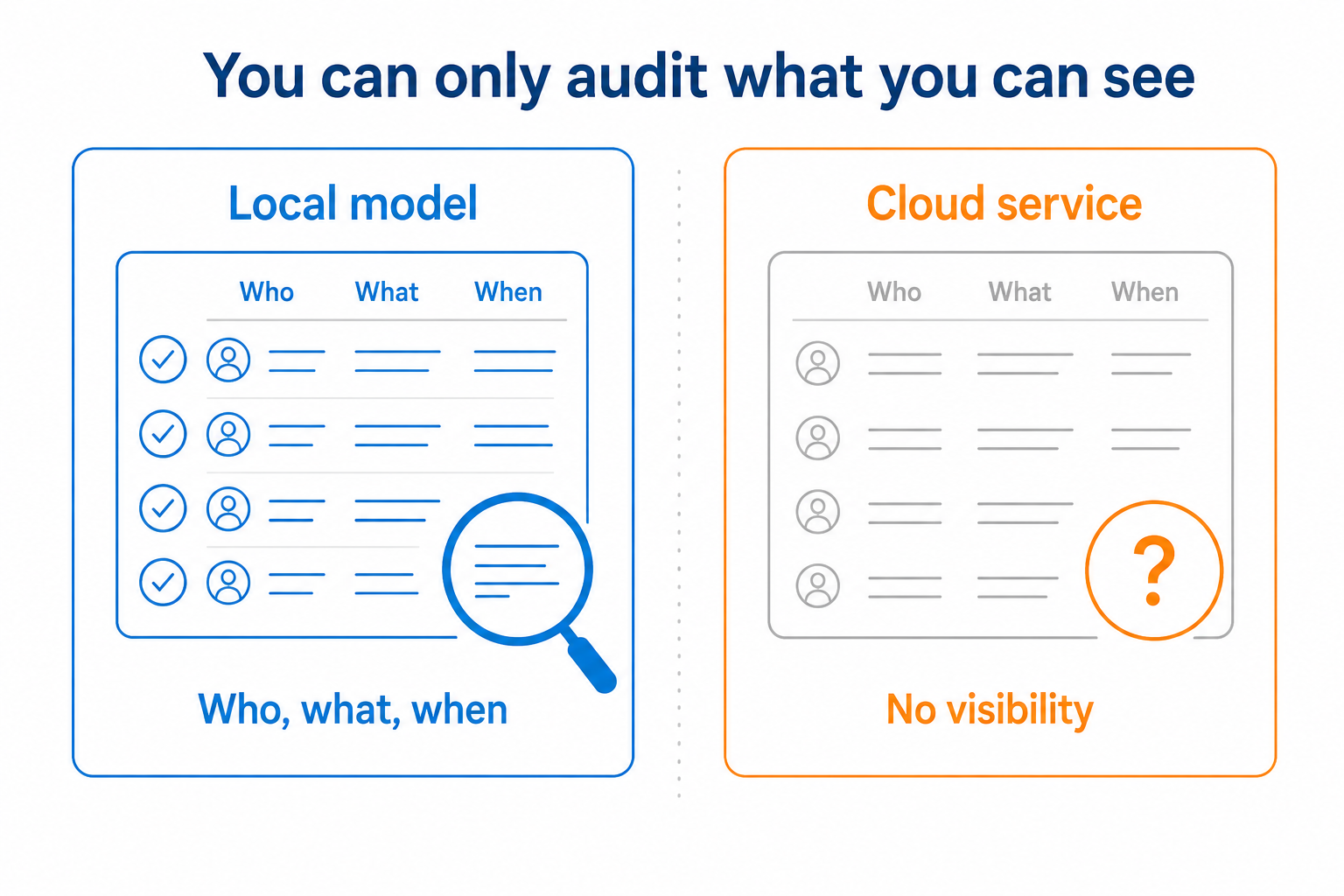
With a model on your own hardware, you own the logs. You can see what was asked, what came back, which user it came from, and when. If a result is later queried, or a process produces the wrong output, you can reconstruct exactly what happened.
With an external service you lose most of that visibility into per-user activity. For regulated work, where you may have to show who did what, a complete audit trail is not a nice-to-have. Owning the model means owning the record.
The runaway-cost risk
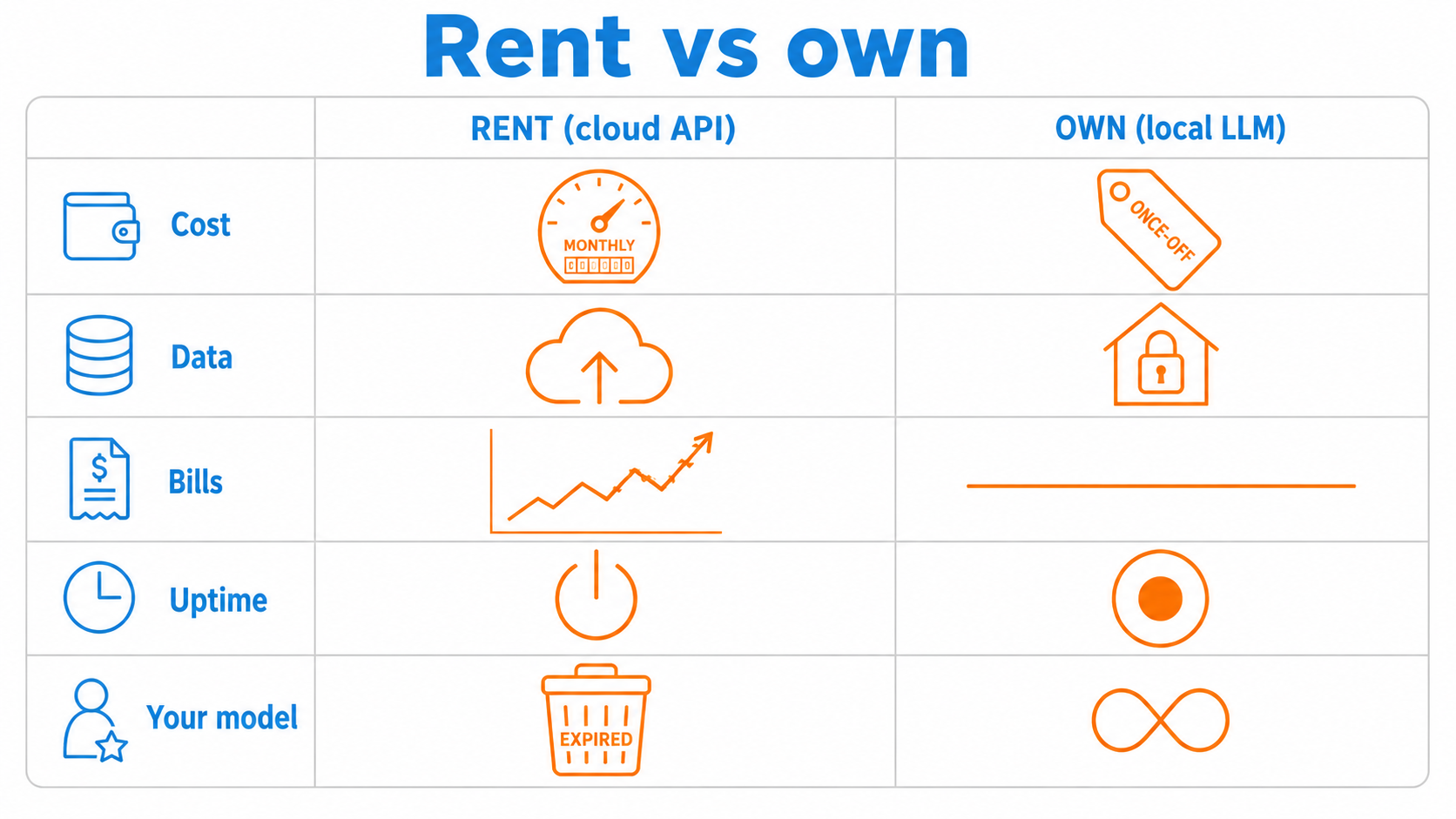
Cloud AI is billed by the token. One enthusiastic user, or a single misconfigured automation, can run up a large bill in a day. Keeping that in check means usage caps, monitoring and a layer of oversight you did not have before.
Owned hardware has a fixed cost. Once it is paid for, the meter does not run, and a novice cannot accidentally spend thousands overnight. For a small firm, predictable is worth a great deal.
What it looks like in practice
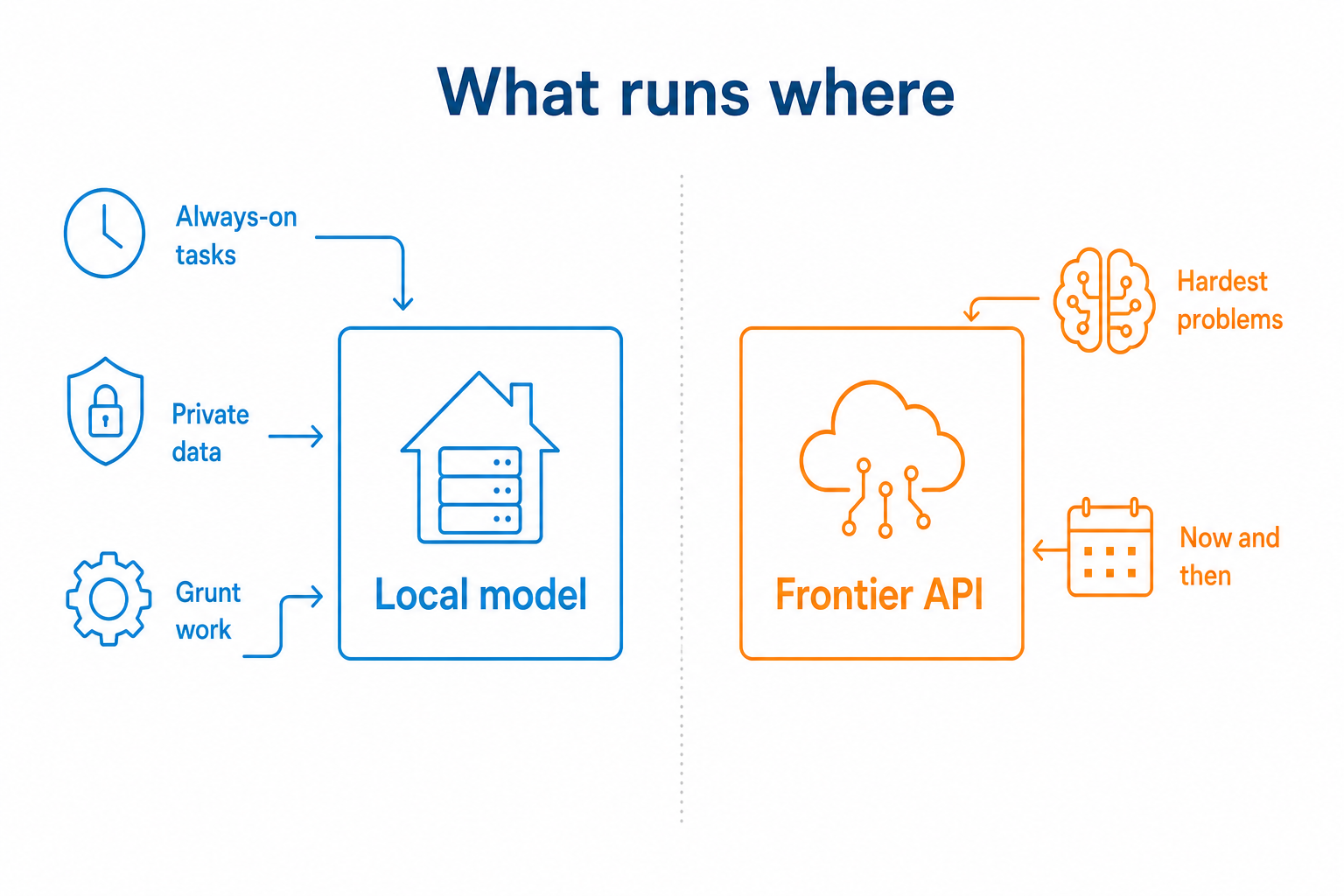
Most firms do not need to go all or nothing. The sensitive work, document review, drafting, extracting data from your own files, runs on a model in your office. Anything that is not confidential can still use a frontier API when you want the extra capability.
The hardware that makes this practical, from a compact machine like the NVIDIA DGX Spark or AMD Strix Halo to a GPU workstation, does not land easily in South Africa. Scott’s Shipping Services imports it, clears it, and delivers it as one all-inclusive quote. For the full breakdown of what to buy, see our guide to importing AI and local-LLM hardware into South Africa, and the wider case for owning your AI hardware. If you want us to source specific parts, that is our international shopping concierge.
Compliance depends on your whole setup, not one tool. What a local model does is remove the cross-border processing question that makes cloud AI hard to square with POPIA, because the data stays on your premises. Confirm the specifics for your practice with a compliance specialist.
Can I not just use the privacy settings on ChatGPT or similar?
Professional and API plans still process your data with a provider outside South Africa, and the strongest data-residency controls are generally enterprise-only. A local model keeps the data in-house, which is a simpler position to defend.
What hardware does a small firm need?
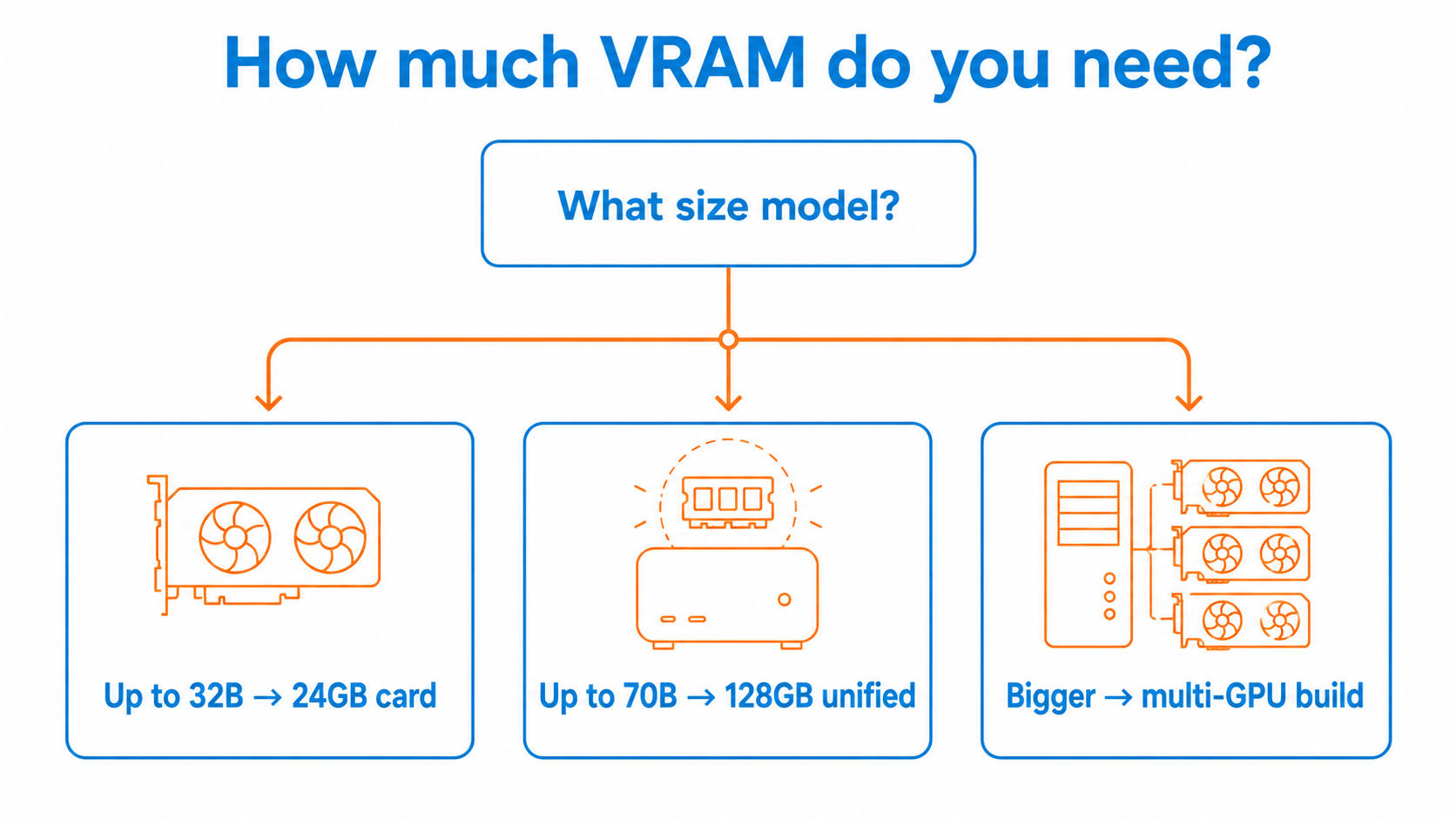
It depends on the size of model you want to run, and the deciding spec is memory. Our guide to importing AI and local-LLM hardware into South Africa breaks down the options, from a single workstation to a turnkey box.
Does SSS give legal or compliance advice?
No. We import the hardware, cleared and delivered. The legal and compliance side is for a specialist in that field. Tell us what you want to run and we will help you land the right kit.
Weighing a private AI setup for your firm? Use our online calculator for a quick estimate, or get in touch to source the hardware.
About the Author
Written by Scott Kirby, founder and director of Scott’s Shipping Services.
With years of hands-on experience in international shipping and South African customs, Scott started SSS to give individuals and businesses a simpler, more transparent way to import. He and his team have handled thousands of shipments from six continents, building a reputation for reliability, compliance, and honest pricing.
Why Run a Local LLM? The Case for Owning Your AI Hardware
Running a local LLM means hosting an AI model on hardware you own instead of renting access through a cloud API. For South African professionals, builders and businesses, owning the hardware is what turns AI from a monthly bill into an asset you control. This is the case for going local: what you gain, who it suits, and the kind of work it already does.
We do not sell the model. What we do is import the hardware it runs on, cleared and delivered to your door, so the estimate below is for landing that kit in South Africa.
It keeps working. A model on your own hardware does not care about sanctions, export bans, account suspensions or a provider pulling out of the South African market. Nobody can switch it off.
Your data stays put. Nothing is uploaded to a third party. For anyone handling client records, case files, patient data or financials, that is the difference between compliant and not under POPIA.
You pay for it once. No subscription, no per-token meter running in the background, no price hike landing on a Tuesday. The cost is the hardware you already own.
No runaway bills. A misconfigured script cannot quietly burn thousands in API tokens overnight. There is no meter to run away with.
You keep what works. A model that suits your workflow will not be deprecated or retired out from under you. Pin the version that works and run it for years.
Right tool, right cost. Run the repetitive, always-on grunt work on your own model, and save the frontier APIs for the genuinely hard problems. Most jobs do not need a flagship model.
Who it is for, and what it does
Professionals who need it now
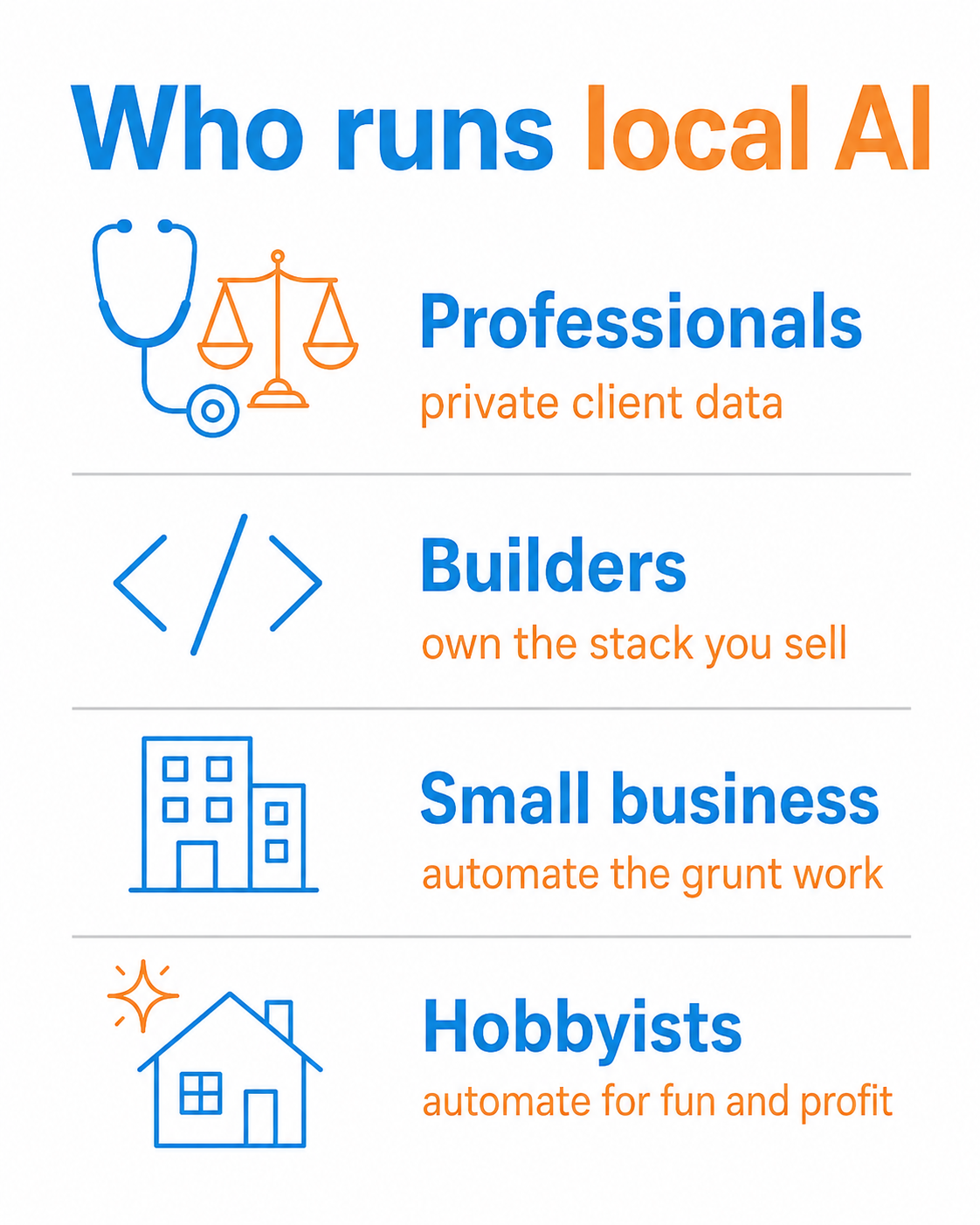
Doctors, lawyers, accountants and developers working with confidential or regulated data cannot push it to a cloud API and hope for the best. Local is the compliant route, and usually the urgent one. The data control, POPIA and audit side of this runs deep, so we covered it on its own: local LLMs for professional firms in South Africa.
Builders and IT consultants
Developers who build AI tools and sell them to several companies need to own the stack they ship. We have built our own at SSS: a custom CRM shaped around how the business runs, and a WhatsApp bot for customer queries, the channel most South Africans actually use. On hardware you control, you build and test without a token meter running, and you are not handing your clients’ workflows to a third party you cannot vouch for.
Small businesses with a clued-up IT person
If you have someone who can put a capable machine in the corner, you can automate the work that quietly eats hours: customs-code classification, email triage, scheduled reporting, social posting. A local model runs the always-on, repetitive end of it while the frontier APIs handle the rest. We walk through the real examples in using a local LLM to automate your small business.
Hobbyists and tinkerers
Plenty of this starts as a hobby and turns into something real: home automation, local camera detection, a themed dashboard on the TV. Running the AI side on your own hardware means no subscription for something you built for yourself, and full freedom to tinker. Ours leans Lord of the Rings, and we show how it fits together in building a local AI home setup.
Where SSS comes in
Every one of these benefits depends on one thing: owning the hardware. That is the part that does not land easily in South Africa.
Scott’s Shipping Services sources the GPUs, mini-supercomputers and high-VRAM cards local models run on, handles the customs classification, duties and VAT, and delivers it landed as one all-inclusive quote. For the full breakdown of what to buy, see our guide to importing AI and local-LLM hardware into South Africa. If you want us to buy specific parts on your behalf, that is our international shopping concierge.
For plenty of work, a cloud API is fine. Local wins when privacy matters, when you want predictable costs instead of a per-token meter, or when the job needs to run all day every day. Many setups do both: local for the routine work, cloud for the hardest problems.
Is a local model as good as ChatGPT or Claude?
The frontier cloud models still lead on the hardest tasks. For everyday work, coding help, summarising, drafting and the repetitive grunt work, open models you can run locally are now strong enough that most users would not notice the difference.
We are the import side: we get the right hardware into South Africa, cleared and delivered. We are not a managed AI service, but tell us what you want to run and we will help you land the parts that fit.
Written by Scott Kirby, founder and director of Scott’s Shipping Services.
With years of hands-on experience in international shipping and South African customs, Scott started SSS to give individuals and businesses a simpler, more transparent way to import. He and his team have handled thousands of shipments from six continents, building a reputation for reliability, compliance, and honest pricing.
Importing AI and Local-LLM Hardware into South Africa
Importing AI hardware into South Africa means getting the GPUs, mini-supercomputers and high-VRAM cards that local LLMs run on past two obstacles: thin local supply and a customs process that treats high-value electronics with suspicion. This guide covers what people are actually running local models on in 2026, the grey-market parts worth knowing about, and how Scott’s Shipping Services brings it in as one all-inclusive price.
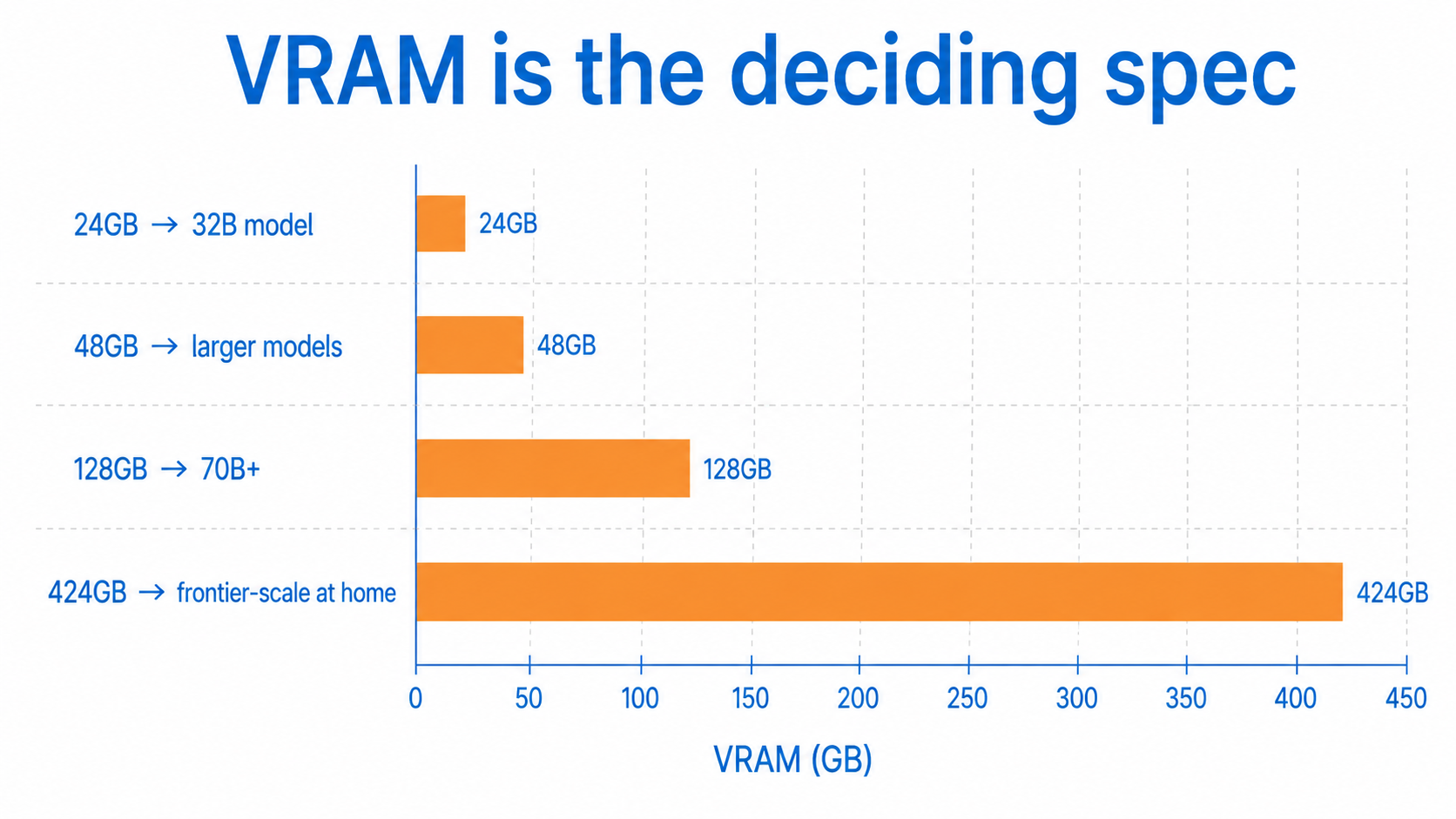
Local LLM hardware is the compute you need to run open-weight models like DeepSeek, Qwen and Llama on your own machine instead of a cloud API. The deciding spec is memory: how much VRAM or unified memory you can put in front of the model.
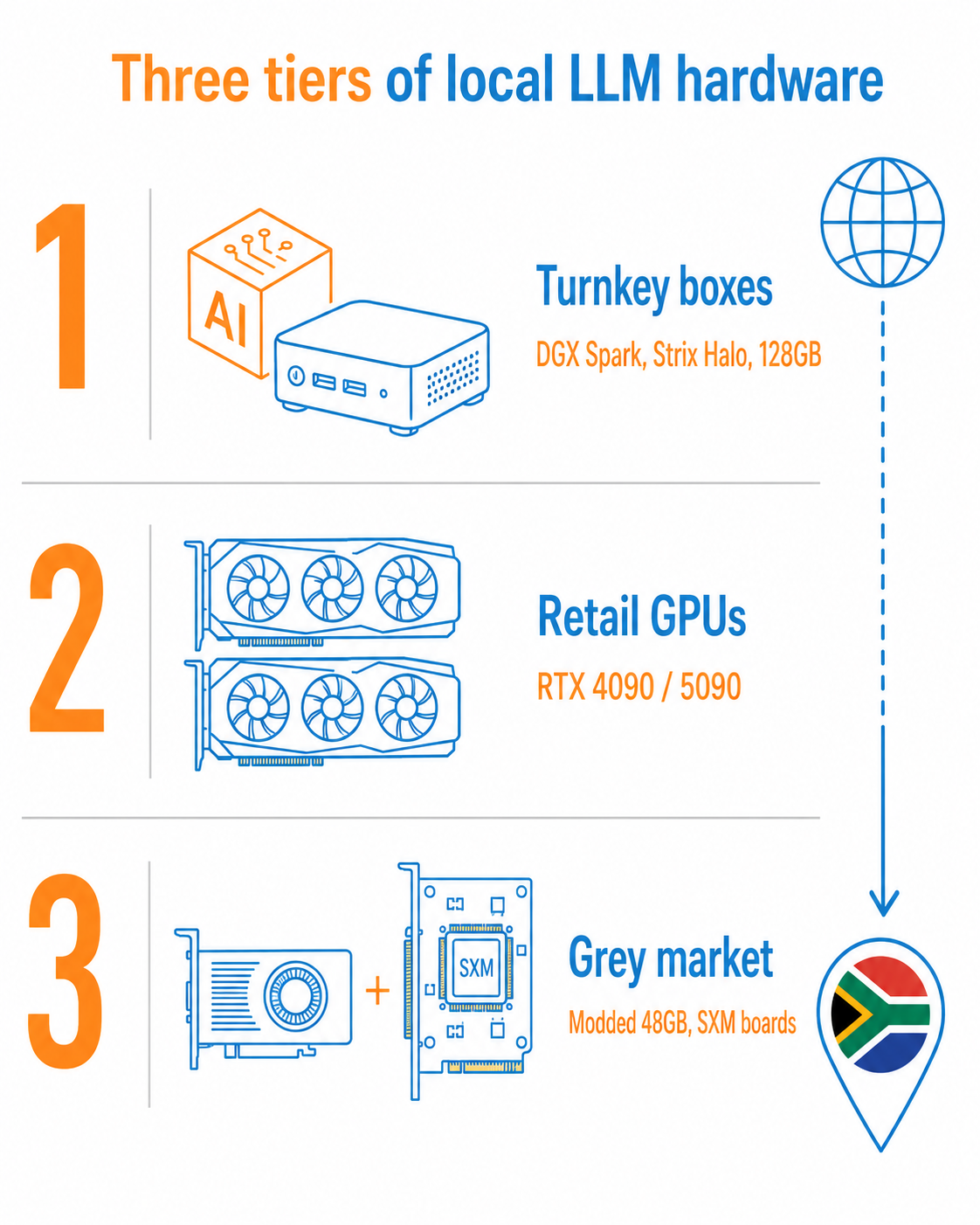
The hardware splits into three tiers. Turnkey boxes like the NVIDIA DGX Spark and AMD Strix Halo mini PCs ship with 128GB of unified memory. Retail GPUs like the RTX 4090 and 5090 remain the single-card workhorses. Grey-market gear covers China-modded 48GB RTX 4090s and ex-datacentre cards mounted on adapter boards.
Almost none of it sits on a South African shelf, and the modded parts carry real risk. SSS sources the hardware, handles the customs classification, duties and VAT, and delivers it landed as one quote.
What is driving the demand
Two things turned self-hosting from a niche hobby into a queue of buyers. The first is the open Chinese models. DeepSeek and Qwen now ship open-weight releases that hold their own against commercial APIs, and at 4-bit quantisation a capable model like DeepSeek-R1 32B fits on a single 24GB card. Good models that run on hardware you can own are the whole driver.
The second is Odysseus, the self-hosted AI workspace released by Felix Kjellberg (PewDiePie) on 31 May 2026. It runs local backends like Ollama, vLLM and llama.cpp, and his own rig of eight modded RTX 4090s plus two RTX 4000 Ada cards put a real number on what a serious local setup looks like. The result is a wave of people pricing their own builds.
What people actually run local LLMs on
Turnkey boxes: DGX Spark and Strix Halo
The NVIDIA DGX Spark is built around the Grace Blackwell GB10 chip with 128GB of unified memory, enough to load models up to roughly 200 billion parameters in NVFP4. It runs them at around 35 to 80 tokens per second, with memory bandwidth near 273 GB/s as the main limit. Even abroad it has been supply-constrained, with multi-week lead times.
The AMD Strix Halo (Ryzen AI Max+ 395) pairs 16 Zen 5 cores with an integrated Radeon 8060S and up to 128GB of shared memory, leaving roughly 115 to 120GB usable for inference. It loads a 70B model without splitting it across cards and pushes a 30B model at around 100 tokens per second. It has become the practical all-rounder for a quiet desktop or air-gapped build.
Retail GPUs: RTX 4090 and 5090
The RTX 4090 with 24GB remains the best single-card option, handling 32B models at Q4 with room for cache. The RTX 5090 at 32GB lifts that ceiling, and two cards together open up larger models. The constraint in South Africa is not whether they work, it is getting current stock at a sane price.
The grey market: modded cards and adapter boards
This is where the buzz gets loud and the risk gets real.
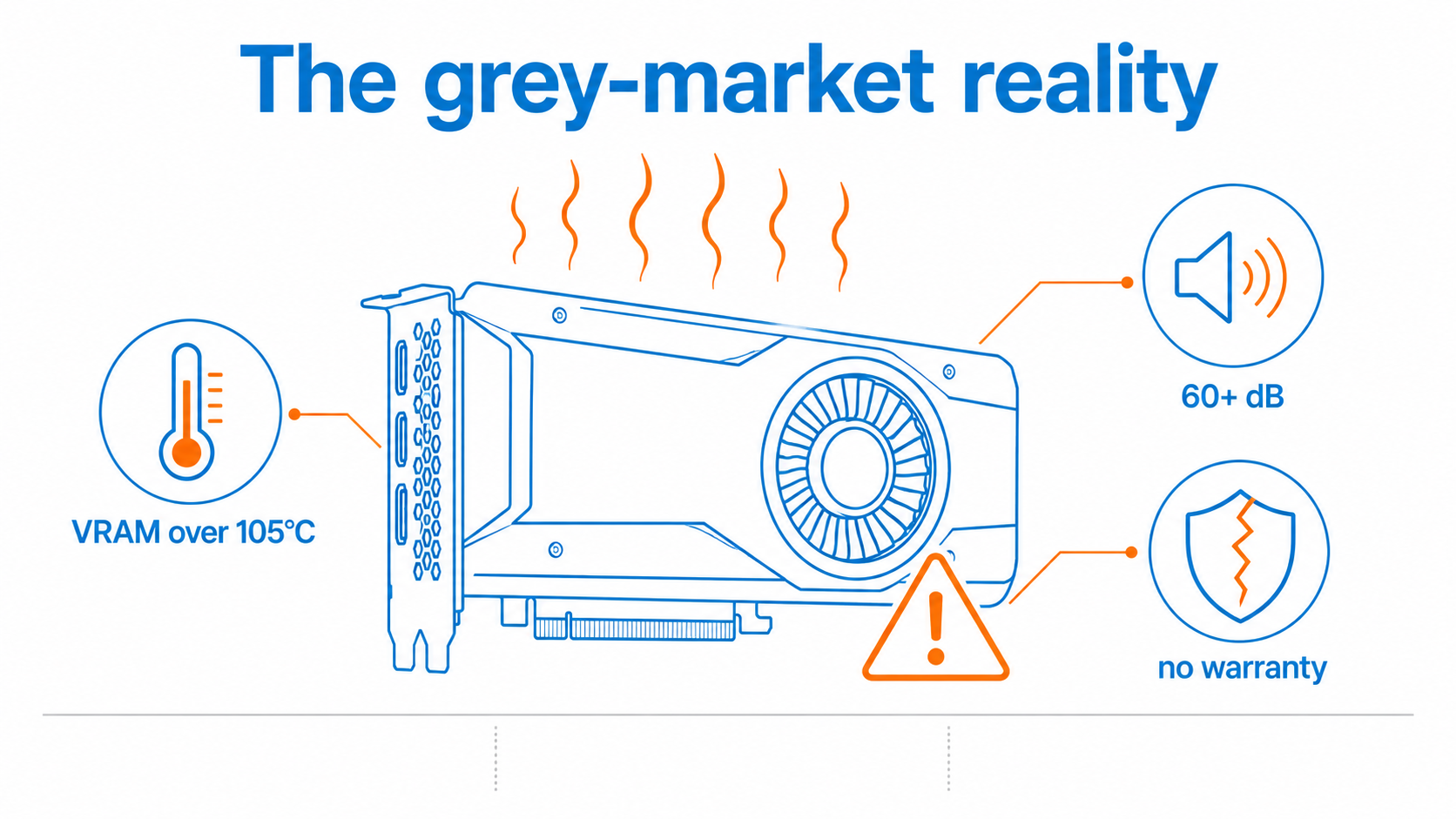
Modded 48GB RTX 4090s. NVIDIA never made a 48GB 4090. These are custom builds out of China that reball the memory to double the VRAM, sold mostly on Alibaba and AliExpress as blower-style cards. On paper a 48GB card for large-model work is tempting. In practice, independent reviewers have measured VRAM temperatures above 105°C, blower noise past 60 dB, and stress-test failure rates several times higher than stock cards, often built on second-hand chips with no warranty.
SXM2 and SXM4 adapter boards. These breakout boards drop ex-datacentre modules like the Tesla V100, P100 and A100 into a normal PCIe slot. The VRAM-per-rand maths looks great, but power delivery, cooling and BIOS quirks make these a project build, not a plug-and-play card.
The grey market is exactly where buying blind costs money. A card that arrives dead, or cooks itself in a fortnight, has no recourse when you ordered it solo off a marketplace listing. This is the part of the market where knowing which sellers and which parts are worth touching is the whole value.
Memory and storage worth importing too
Compute is only half a build. Running a model larger than your VRAM means offloading layers to system memory, so DDR5 capacity and speed matter for anyone pushing past their card. Model weights also have to live somewhere fast: a 70B model at Q4 is around 40GB, and the largest open models run into hundreds of gigabytes, so a quick NVMe SSD earns its place.
It is usually worth importing the RAM and storage on the same shipment as the compute. One consignment, one customs entry, one delivery.
Why this hardware is hard to get in South Africa
Local stock is thin past a retail 4090. Turnkey AI boxes and datacentre-class cards rarely reach South African shelves at all, and when they do the markup reflects the scarcity.
High-value electronics also draw SARS attention. Correct tariff classification, an honest customs value, duties where they apply and VAT at 15% are all part of the entry. Get the paperwork wrong and a costly parcel sits in limbo while it is queried. For how that valuation is worked out, see our guide on how customs value is determined in South Africa.
Buying grey-market parts yourself stacks a second risk on top: if the card is faulty on arrival, you are arguing with an overseas marketplace seller, not a local supplier.
How SSS gets it in for you
Scott’s Shipping Services is an end-to-end import service. We buy the hardware, ship it, clear it through customs, pay the duties and VAT, and deliver it to your door as one all-inclusive quote. We do not do clearing-only work or handle goods you have already bought.
Sourcing judgement. We work with reputable suppliers, and where a build calls for grey-market parts we know which sellers and which cards are worth the risk and which to avoid.
Clean customs entries. High-value electronics get the correct HS classification and an honest customs value before they ship, so clearance stays fast and defensible if SARS asks questions.
Can you import a DGX Spark or Strix Halo machine to South Africa?
Yes. We source turnkey AI machines like the NVIDIA DGX Spark and AMD Strix Halo mini PCs from overseas suppliers and handle the full import, including customs, VAT and delivery. Lead times depend on stock abroad, which has been tight, so it is worth asking early.
Are the China-modded 48GB RTX 4090 cards worth it?
Sometimes, with eyes open. They offer a lot of VRAM, but they are custom builds with reported thermal and reliability problems and no warranty. If a build genuinely needs that much VRAM, we can advise on whether a modded card or a different route makes more sense, and source accordingly.
Can you get ex-server GPUs like the V100 or A100 and the adapter boards?
Yes. We can source datacentre cards and the SXM-to-PCIe adapter boards they need. These are involved builds, so we will be straight with you about the power and cooling they demand before you commit.
Do I pay duty and VAT on AI hardware?
VAT at 15% applies to imported hardware. Whether duty applies, and at what rate, depends on the exact tariff classification of the item. We confirm the classification and the full landed cost before you commit, so there are no surprises at clearance.
What does it cost to import a local LLM rig?
It depends on the parts, the source country and the shipment weight. We quote the whole job as one figure, with the hardware, shipping, customs, duties, VAT and delivery included. Get a quick estimate to see your landed cost.
Can SSS advise on what hardware to buy?
We are importers, not a build shop, but we know the market well. Tell us the models you want to run or the rig you are copying, and we will help you land the right parts reliably.
Planning an AI or local-LLM build? Use our online calculator for a quick estimate, or get in touch to source the parts.
About the Author
Written by Scott Kirby, founder and director of Scott’s Shipping Services.
With years of hands-on experience in international shipping and South African customs, Scott started SSS to give individuals and businesses a simpler, more transparent way to import. He and his team have handled thousands of shipments from six continents, building a reputation for reliability, compliance, and honest pricing.
Prohibited and Restricted Imports in South Africa: What You Can and Can’t Bring In
South Africa sorts controlled goods into two groups. Prohibited items may never be imported. Restricted items are allowed only if you hold the correct permit or authority before the goods arrive. Import the wrong thing, or the right thing without the right paperwork, and SARS can detain, seize, or destroy the shipment, with no refund from the seller. This guide explains the difference, lists the categories that catch people out, and shows how to check before you buy.
Most everyday online purchases (electronics, clothing, hobby gear, homeware) import without special permits, though duty and VAT still apply. The items that need extra care fall into a smaller set: anything regulated for safety, health, security, or trade-protection reasons. If your order touches medicines, food, plants, animal products, firearms, radio or telecoms equipment, or used goods, assume a permit or approval is required and confirm it before you pay. For how those costs are calculated once an item is cleared to enter, see our guide to how customs value is determined.
Prohibited vs restricted: the difference
The two terms are often used interchangeably, but they are not the same thing.
Prohibited goods cannot be imported under any circumstances. There is no permit that makes them legal.
Restricted goods can be imported, but only with the correct permit, licence, or letter of authority issued by the relevant South African authority before the shipment arrives.
Several different bodies control imports, not just SARS. SARS handles customs clearance, but the permit itself usually comes from another regulator: ITAC for import permits and used goods, the NRCS for regulated products, ICASA for radio and telecoms equipment, SAHPRA for medicines and health products, and the Department of Agriculture for food, plants, and animal products. Knowing which body governs your item is half the battle.
Goods commonly prohibited
The following are generally not allowed into South Africa at all:
Narcotics and illegal drugs
Counterfeit and trademark-infringing goods (fake branded clothing, shoes, electronics, and accessories)
Certain weapons, including some knife types and prohibited firearm categories
Hazardous and toxic waste
Used and retreaded pneumatic tyres
Pornographic or obscene material as defined under South African law
This is not an exhaustive list, and definitions matter. A folding knife may be fine while a specific concealed or automatic type is not. When a category is borderline, treat it as prohibited until confirmed otherwise.
Goods that need a permit or authority
These can be imported, but only with the right approval in place first. Our FAQ lists the restricted and prohibited categories we see most often.
Firearms and ammunition
Importing firearms requires a permit and the appropriate competency and licensing through the South African Police Service. This is a slow, document-heavy process and not something to start after the goods have shipped.
Medicines, supplements, and health products
Medicines and many supplements fall under SAHPRA. Some require registration or a specific authorisation to bring in, even for personal use. Vitamins and common supplements sit in a grey area and are frequently held at customs.
Food, plants, and animal products
Foodstuffs, seeds, plants, and anything of animal origin are controlled by the Department of Agriculture and may need import permits and health certificates. Many are refused outright on biosecurity grounds.
Radio, wireless, and telecoms equipment
Devices that transmit (two-way radios, signal boosters, some drones, and certain smart-home gear) need ICASA type approval. Read more in our guide to importing smart home devices.
Regulated electrical and consumer products
Many electrical goods, appliances, and certain consumer products require an NRCS Letter of Authority to confirm they meet compulsory safety specifications. Our guide to importing electronics to South Africa covers where this applies.
Used and second-hand goods
Used goods, from clothing to machinery to vehicles, generally require an ITAC import permit. Second-hand vehicle imports in particular are tightly controlled.
Grey areas that trip people up
Some of the most common customs hold-ups involve items buyers assume are fine:
Supplements and protein powders. Routinely stopped pending SAHPRA or health clearance.
Vapes and e-cigarettes. Increasingly regulated and taxed; rules are tightening.
Drones. May need both ICASA approval and civil aviation registration depending on the model.
Replica and “inspired by” branded goods. Treated as counterfeit if they carry protected marks.
Lithium batteries and powered devices. Not prohibited, but classed as dangerous goods. They need a Material Safety Data Sheet and are subject to carrier rules. See our note on this in the air vs sea freight guide.
If a restricted item arrives without the required permit, SARS will hold it. Depending on the goods, you may be able to apply for the permit retrospectively (slow, and storage fees accrue while you wait), or the shipment may be seized and destroyed. Prohibited goods are simply confiscated. In all cases the seller is unlikely to refund you, so the loss is yours. Honest declarations and correct permits are far cheaper than the alternative.
How to check before you buy
Identify the category. Is it electrical, wireless, ingestible, animal or plant based, a weapon, or used? Any “yes” means check further.
Find the controlling authority. Match the item to the right body (ITAC, NRCS, ICASA, SAHPRA, SAPS, or Agriculture).
Confirm the permit before paying. Never order first and sort paperwork later.
Keep your invoice and product details. Customs may ask for them during clearance.
Ask if you are unsure. Five minutes of checking can save you the cost of the goods.
Scott’s Shipping Services reviews every order against current import rules before we buy anything. If an item is prohibited, we tell you upfront rather than letting it ship and get seized. If it is restricted, we flag what permit or approval is needed so you can decide how to proceed. Because we manage purchasing, shipping, customs clearance, and delivery as one all-inclusive service, compliance is built into the quote rather than left for you to untangle at the border.
What items are prohibited from import into South Africa?
Narcotics, counterfeit goods, certain weapons, hazardous waste, used tyres, and obscene material are generally prohibited and cannot be imported under any permit. Definitions are specific, so borderline items should be treated as prohibited until confirmed.
What is the difference between prohibited and restricted goods?
Prohibited goods can never be imported. Restricted goods can be imported, but only if you hold the correct permit or authority before the shipment arrives. The permit usually comes from a regulator such as ITAC, NRCS, ICASA, SAHPRA, SAPS, or the Department of Agriculture, not from SARS.
Can I import supplements and vitamins into South Africa?
Sometimes, but they are frequently held at customs pending health clearance through SAHPRA. Some products require authorisation even for personal use. Confirm the specific product before ordering.
Do I need a permit to import electronics?
Standard consumer electronics usually clear without a special permit, though duty and VAT apply. However, products that transmit a signal may need ICASA type approval, and certain regulated electrical goods need an NRCS Letter of Authority.
What happens if my restricted item arrives without a permit?
SARS will hold the shipment. You may be able to apply for the permit afterwards while storage fees accrue, or the goods may be seized and destroyed. The seller will usually not refund you, so the loss falls to you.
Does SSS check whether my item is allowed before buying?
Yes. We review every order against current import restrictions before purchase. If something is prohibited or needs a permit, we tell you before any money is spent on the goods.
Not sure whether your item is allowed? Use our online calculator for a quick estimate, or get in touch and we’ll check it for you before you buy.
About the Author
Written by Scott Kirby, founder and director of Scott’s Shipping Services.
With years of hands-on experience in international shipping and South African customs, Scott started SSS to give individuals and businesses a simpler, more transparent way to import. He and his team have handled thousands of shipments from six continents, building a reputation for reliability, compliance, and honest pricing.
Air Freight vs Sea Freight to South Africa: How to Choose
Choosing between air freight and sea freight is the first decision you will make when importing anything over 30 kg into South Africa. The right choice depends on three things: how heavy the shipment is, how fast you need it, and how much you are willing to spend. This guide covers the practical differences so you can decide before you request a freight quote.
Air freight vs sea freight at a glance
Air Freight
Sea Freight
Best for
30 to 100 kg, items under 1 m on any side
100 kg+ up to full 40 ft containers
Typical timeline
2 to 3 weeks door to door
2 to 3 months door to door
Cost per kg
Higher; best for lighter, time-sensitive goods
Lower; best for bulk or heavy shipments
Size limits
Restricted by aircraft cargo hold
Up to full container (20 ft / 40 ft)
Timelines start once the goods are collected from the supplier or delivered to the port of origin. Actual transit depends on the origin country, routing, and customs processing.
When air freight makes sense
Air freight suits shipments between 30 and 100 kg where no single dimension exceeds one metre. It is the faster option by a wide margin, and for goods in this weight range the cost difference is often less dramatic than people expect, particularly from major hubs like the US, UK, and EU where flight frequency keeps rates competitive.
Common air freight imports include specialist equipment, electronics, automotive parts, and medical devices. If the item is expensive relative to its weight, air freight is almost always the better value because you reduce time in transit and lower the risk of damage from extended handling.
When sea freight makes sense
Sea freight is designed for volume. Once a shipment crosses the 100 kg mark, or when the items are physically large, ocean shipping becomes significantly cheaper per kilogram. For full container loads the economics are even more favourable.
There are two sea freight options. LCL (Less than Container Load) means your cargo shares a consolidated container with other shipments, the standard for loads that do not justify a full container. FCL (Full Container Load) gives you a dedicated 20 ft or 40 ft container when the volume warrants it.
Typical sea freight imports include gym equipment, industrial machinery, furniture, building materials, and bulk stock for small businesses. If timing is flexible and the shipment is heavy, sea freight will save you money.
How costs are calculated
Freight costs feed into your total customs value (CIF), which SARS uses to calculate duties and VAT. CIF stands for Cost + Insurance + Freight, so the shipping method you choose directly affects how much duty you pay.
With SSS, this is rolled into a single rand quote. Product cost, international freight, customs duties, 15% VAT, and local delivery are all included. No foreign currency transfers, no separate customs broker fees, no surprises. The number we quote is the number you pay.
You also do not need your own importer’s code (here is why). We clear under our own customs licence and issue you a standard South African tax invoice.
What about shipping terms?
Your supplier’s shipping terms (Incoterms) affect who arranges what. SSS works with three:
EXW (Ex Works): we collect directly from the supplier. You provide their details and we handle everything from their door to yours.
FOB (Free on Board): the supplier delivers to their nearest port. We take over from there.
DDP (Delivered Duty Paid): the supplier arranges shipping. Our role is limited to payment and import paperwork.
Not sure which terms your supplier is offering? Their proforma invoice will usually state it. If it does not, ask, because it affects your quote. More on avoiding costly mistakes in our guide to common importing mistakes.
Hazardous and restricted goods
Both air and sea freight have restrictions on what can be shipped. Lithium batteries, aerosols, flammable liquids, and certain chemicals require a Material Safety Data Sheet (MSDS). Some items need additional clearance from South African authorities before they can be imported.
If your shipment contains anything hazardous or restricted, declare it upfront. Incorrect declarations cause delays, and in some cases the goods may be rejected entirely. Full details are in our shipping restrictions FAQ.
How to get started
The process is the same regardless of whether you choose air or sea freight. Send us the details of what you want to import (supplier information, a proforma invoice, and the package dimensions and weight) and we will quote you a single all-inclusive price in rands.
Air against sea is one decision inside a larger one. What a complete landed cost has to include, how the Incoterm you buy on changes the shape of a quote, where the LCL and FCL crossover actually sits, and how duty and VAT are calculated are all covered in our full guide to freight importing to South Africa.
Should I use air freight or sea freight to South Africa?
It depends on weight and urgency. Air freight suits shipments of 30 to 100 kg where speed matters. Sea freight is better for anything over 100 kg or where timing is flexible, because the cost per kilogram is significantly lower.
How long does sea freight take to South Africa?
Expect 2 to 3 months from the point the goods leave the supplier, including customs clearance and local delivery. Transit time varies by origin country and port congestion.
How much does air freight cost to South Africa?
Air freight costs more per kilogram than sea freight, but the exact amount depends on weight, dimensions, origin country, and the type of goods. SSS quotes all-inclusive in rands: freight, duties, VAT, and delivery in one number.
Do I need an importer’s code to use freight shipping?
No. SSS clears under its own customs licence, so you do not need to register with SARS or hold your own importer’s code. We issue you a standard South African tax invoice.
What is the difference between LCL and FCL?
LCL (Less than Container Load) means your cargo shares a container with other shipments. FCL (Full Container Load) gives you a dedicated container. LCL is standard for most imports; FCL is more cost-effective when you have enough volume to justify a full 20 ft or 40 ft container.
Can I import hazardous goods by freight?
Some hazardous goods can be imported, but they require a Material Safety Data Sheet (MSDS) and may need additional clearance documents. Declare hazardous items upfront. Undeclared goods cause delays or rejection.
Planning your next import? Use our online calculator for a quick estimate, or get in touch for advice on your shipment.
About the Author
Written by Scott Kirby, Director of Scott’s Shipping Services.
Scott is the founder and director of Scott’s Shipping Services, a trusted name in international shipping and customs clearance in South Africa. With over a decade of experience helping hundreds of individuals and businesses import goods safely and efficiently, Scott combines technical expertise with practical know-how. His team has managed over 5,000 successful shipments globally, earning a reputation for reliability, transparency, and hassle-free service.
South Africans can buy from Etsy, but most sellers don’t ship here directly, and those that do rarely quote customs duties or VAT upfront. The simplest route is to use a managed import service like Scott’s Shipping Services (SSS), which handles the purchase, international shipping, customs clearance, and door-to-door delivery for one all-inclusive price. This guide covers every option, the real costs involved, and the risks you should know about before placing an order.
Yes. Etsy is accessible from South Africa, and there is nothing stopping you from browsing or placing orders. The catch is that Etsy is not a single retailer. Every listing is run by an individual seller, which means shipping policies, costs, and reliability vary from one shop to the next.
In practice, this creates several problems for South African buyers:
Many sellers do not offer shipping to South Africa at all
Those that do often use slow, untracked postal services
Shipping costs are frequently inflated or inaccurate
Delivery timelines are unpredictable
Etsy itself does not handle logistics. The seller is solely responsible for packaging, dispatch, and choosing a shipping method. That lack of standardisation is where most problems begin. Understanding how to spot reputable online sellers is especially important on marketplace platforms like Etsy.
How shipping from Etsy to South Africa works
There are three main ways to get an Etsy order delivered to South Africa.
1. Direct shipping from the seller
The seller ships your order using their chosen postal service or courier. This is the simplest option on paper, but it carries the most risk. Tracking is often limited, customs handling is unpredictable, and if anything goes wrong, you are dealing with an individual seller in another country.
2. Freight Forwarder
You ship the item to a warehouse address overseas (typically in the US or UK), and a freight forwarding company sends it onward to South Africa. This gives you more control over the international leg, but you still manage customs clearance, duties, and VAT yourself.
3. Fully managed import via SSS
SSS handles the entire process: we purchase the item on your behalf, receive it at our international address, ship it to South Africa, clear it through customs, pay the duties and VAT, and deliver it to your door. One quote upfront, no surprises. For a detailed breakdown, see our step-by-step process guide.
What does it cost to import from Etsy to South Africa?
The total landed cost of an Etsy import is more than just the item price. Several additional charges apply, and most buyers underestimate them.
Cost Component
What It Covers
Typical Range
Item Price
The listed price on Etsy (usually in USD, GBP, or EUR)
Varies
International Shipping
Seller’s shipping charge or forwarding cost
$15 – $80+
Customs Duty
Determined by product type and HS code classification
0% – 45%
VAT
15% applied to item price + shipping + duty combined
15%
Clearance Fees
Charged by the courier or clearing agent processing your parcel
R150 – R500+
Why cost surprises happen
When you order directly from Etsy, the checkout total only reflects the item price and the seller’s shipping charge. Customs duty, VAT, and clearance fees appear later, often as a demand-for-payment from the courier before they release your parcel.
The VAT calculation catches most people off guard. SARS applies 15% VAT not just to the item price, but to the item price plus shipping plus any duty charged. On a R2,000 item with R500 shipping and 20% duty, the VAT alone adds over R400. For a full explanation of how this calculation works, see our post on how customs value is determined.
Tip: Request a full landed-cost quote before purchasing. This is the single most effective way to avoid unexpected charges on arrival.
How long does delivery take?
Shipping Method
Typical Timeframe
Tracking
Postal Service (e.g. USPS, Royal Mail)
3–8 weeks
Limited or none
Express Courier (DHL, FedEx, UPS)
5–10 business days
Full tracking
SSS Managed Shipping
10–21 business days (origin-dependent)
Full tracking with updates
Delays commonly occur because of seller dispatch times (some Etsy sellers take 1–3 weeks to make or ship custom items), customs inspections, or incomplete documentation. SSS manages seller communication and ensures documentation is correct before the item ships, which reduces the most common causes of delay.
Common risks when buying from Etsy internationally
Etsy’s marketplace model means you are buying from individuals, not from a company with standardised quality control or shipping infrastructure. That introduces risks you would not face with a large retailer like Amazon.
Incorrect or misrepresented items. What arrives may not match the listing photos, especially with handmade or custom-made goods.
Lost or untracked shipments. Postal services between countries offer limited visibility. Once a parcel enters the international mail system, tracking often stops until it reaches South Africa.
Communication gaps. Time zone differences and language barriers can make resolving issues with sellers slow and frustrating.
No practical return option. Returning an item from South Africa to an international seller typically costs more than the item is worth, and the process is entirely at your expense.
These are among the most common importing mistakes that cost South African buyers money.
Warning: Once an item has shipped internationally, resolving disputes becomes significantly harder. Etsy’s buyer protection has limits, and cross-border returns are rarely practical or cost-effective.
When should you use SSS instead of DIY?
SSS is the better option when any of the following apply:
The seller does not ship to South Africa
The item is high-value, fragile, or custom-made
You want to know the full cost before committing
You have been stung by unexpected customs charges before
You simply do not want to deal with international logistics
DIY importing can work for low-value, low-risk items where the seller offers tracked shipping. But for anything above a few hundred rand, the savings often disappear once you factor in duty miscalculations, courier clearance fees, and the time spent chasing a parcel. For a broader view of why using a managed service makes sense, see our post on the benefits of using an import company.
All SSS shipments are insured during transit, and if something goes wrong, you deal with us directly rather than chasing an individual seller across time zones.
Step-by-step: how to import from Etsy using SSS
Find the item you want on Etsy and copy the product link
We send you a full, all-inclusive landed-cost quote
Once you approve, we purchase the item and coordinate with the seller
We manage international shipping and customs clearance
Your item is delivered to your door in South Africa
Most quotes are returned within 24 hours. For standard items, the entire process from purchase to delivery typically takes 2–4 weeks depending on the seller’s location and dispatch time. For more detail on each stage, see our full import process guide.
Frequently asked questions
Do I have to pay customs duty on Etsy orders to South Africa?
Yes. Any goods imported into South Africa are subject to customs duty based on the product type and its HS code classification. Duty rates range from 0% to 45%. VAT at 15% is charged on top of the item price, shipping cost, and duty combined. These charges are not included in Etsy’s checkout total.
Can Etsy sellers ship directly to South Africa?
Some can, but most do not. Each Etsy seller sets their own shipping destinations, and South Africa is not a default option for many international shops. Even when a seller does offer it, they typically use slow postal services with limited or no tracking.
What happens if my Etsy order gets stuck in customs?
Parcels can be held at customs if the documentation is incomplete, the declared value looks incorrect, or the goods require additional inspection. You will usually receive a notice from the courier or SARS requesting further information or payment before the parcel is released. With SSS, we handle all customs documentation upfront, which prevents most common hold-ups.
Is it worth using SSS for small Etsy purchases?
For items under a few hundred rand where the seller offers tracked shipping, DIY can work. For anything higher in value, fragile, or from a seller who does not ship to South Africa, the cost of unexpected duties, clearance fees, and potential loss typically outweighs the service fee.
Planning your next import? Use our online calculator for a quick estimate, or get in touch for advice on your shipment.
About the Author
Written by Scott Kirby, founder and director of Scott’s Shipping Services.
With years of hands-on experience in international shipping and South African customs, Scott started SSS to give individuals and businesses a simpler, more transparent way to import. He and his team have handled thousands of shipments from six continents, building a reputation for reliability, compliance, and honest pricing.
Why South African SMEs Choose All-Inclusive Importing with Scott’s Shipping Services
If you want to import goods for your business in South Africa, the real problem is rarely finding a supplier. It is the mess that follows: unclear landed costs, customs surprises, VAT demands at the door, and three different providers blaming each other when something stalls. Scott’s Shipping Services (SSS) removes all of that. One provider, one all-inclusive price covering international shipping, customs clearance, duties, VAT, and delivery to your door.
The reality of importing for South African businesses
Many SMEs start importing informally. A supplier is found overseas. A courier quote looks reasonable. The assumption is that the rest will sort itself out.
This is where problems begin.
Common pain points
Courier quotes that exclude customs duties and VAT. Unexpected SARS clearance delays. Incorrect tariff codes leading to penalties or reassessments. Multiple vendors pointing fingers when something goes wrong. Cash flow disruption caused by surprise costs at arrival. These are among the most common importing mistakes South African businesses make.
For a business importing resale stock or critical equipment, these are not theoretical risks. They directly affect margins, delivery commitments, and customer trust.
What does “all-inclusive importing” actually mean?
“All-inclusive” is used loosely in logistics. At SSS, it has a specific meaning: one quote, one provider, one outcome.
When an SME imports through SSS, the quoted price includes international shipping, customs clearance, import duties (where applicable), VAT, insurance, and delivery to South Africa. That is the price. There is no separate clearing agent invoice. No last-minute SARS payment demand. No “this wasn’t included” email after the goods have landed.
This structure removes the most common source of SME frustration: partial pricing. The number you see before committing to a supplier is the number you pay. For more on why this matters, read about the benefits of using an import company in South Africa.
Why does cost predictability matter more than a low headline price?
SMEs do not fail because importing is expensive. They fail because importing is unpredictable.
A quote that looks cheap but excludes VAT, duties, or compliance costs is not a saving. It is deferred risk. The real cost only becomes clear once the goods land, and by then the margin is already compressed or gone.
What SSS pricing looks like in practice
You know your landed cost before committing to the supplier. There are no working capital shocks at arrival. Resale businesses can plan margins accurately. E-commerce sellers can price products online with confidence. Retailers importing seasonal stock can commit capital knowing exactly what the total outlay will be.
Predictability is not just convenient. For a business managing cash flow month to month, it is a competitive advantage.
Should SMEs handle customs compliance themselves?
They can. But customs compliance is where many otherwise capable businesses get into trouble.
South African import regulations are enforced by SARS. Errors are not handled casually. Incorrect tariff classification, undervaluation, incomplete documentation, or non-compliant product categories can result in penalties, delays, and inspections. For SMEs whose focus should be on sales and operations, these are expensive distractions.
How SSS handles the compliance layer
SSS manages customs classification, SARS declarations, documentation trails, and alignment with current import requirements on behalf of the importer. This does not eliminate regulation. It eliminates uncertainty. You can read more about how customs value is determined in South Africa if you want the detail without needing to manage it yourself.
How does SSS compare to DIY and fragmented services?
Most SMEs weigh three alternatives before choosing a provider.
Option
Risk Profile
Cost Clarity
Management Load
DIY Courier Imports
High
Low
High
Separate Courier + Clearing Agent
Medium
Medium
High
SSS All-Inclusive Service
Low
High
Low
The difference is not speed or access. It is accountability. With SSS, one provider owns the outcome. If something goes wrong, you are not coordinating between a courier, a clearing agent, and a customs consultant. One call. One resolution.
Which types of SMEs use SSS?
Without naming clients, these are the patterns SSS sees most often.
E-Commerce Sellers
Businesses importing repeat stock from platforms like Amazon or Asian suppliers need consistent landed costs to price competitively. SSS enables stable pricing models by removing cost variability. If you sell online and import regularly, knowing your exact landed cost per unit is non-negotiable.
Retail and wholesale stock importers
SMEs importing resale goods benefit from knowing total landed costs before committing capital. This supports accurate margin and cash flow planning, particularly for seasonal buying cycles.
Project-based imports
Engineering firms, installers, and technical service providers often import specialised equipment on tight timelines. Delays or compliance issues can halt entire projects. SSS prioritises documentation accuracy and predictable delivery windows for these shipments. Electronics and specialised tools are among the most commonly imported items in this category.
Importing from global marketplaces
SSS regularly assists SMEs importing from international platforms and suppliers. Whether you are buying from Amazon US, Amazon UK, or sourcing directly from manufacturers, the process is the same: SSS handles purchasing, international shipping, customs clearance, and delivery as one managed service.
SSS is best suited to SMEs that import regularly or plan to scale imports, need predictable landed costs, cannot afford customs delays or penalties, and prefer operational simplicity over piecemeal services.
SSS is not positioned as the cheapest option on paper. It is positioned as the lowest-risk option in practice. If your priority is a headline-low courier rate and you are comfortable managing customs yourself, SSS is probably not the right fit. If your priority is knowing what you will pay, when it will arrive, and that compliance is handled, it is.
Frequently asked questions
What does “all-inclusive” cover at SSS?
An SSS all-inclusive quote covers international shipping, customs clearance, import duties, VAT, insurance, and delivery to your address in South Africa. There are no additional invoices or surprise charges after the goods land.
Can SSS handle goods I have already purchased overseas?
No. SSS provides end-to-end importing, which means SSS handles the purchase from the supplier as well as shipping and clearance. If you have already bought goods and need shipping or clearing only, SSS is not the right provider for that shipment.
Does SSS work with businesses importing small quantities?
Yes. SSS works with SMEs of all sizes, from single-item imports of specialised equipment to regular bulk stock orders. The service is structured around your shipment, not a minimum volume.
Who handles customs if something goes wrong?
SSS does. Because SSS manages the full import chain, any customs queries, documentation issues, or SARS interactions are handled by SSS on your behalf. You do not need to engage with SARS or a separate clearing agent.
Getting Started
You can start with a high-level cost indication before making any decisions. Use the Quick Estimate calculator for early-stage planning, or request a full import quote when you are ready to proceed. Both options are designed to inform, not pressure.
Importing should support your business growth, not compete with it for your attention. If you want clarity instead of complexity, the next step is simple.
If you’re planning your next import, don’t leave it to chance. Scott’s Shipping Services is here to make the process smooth,
cost-effective, and fully compliant. Get your quick estimate today
using our online calculator,
or contact us for expert advice on your shipment.
About the Author
Written by Scott Kirby, Director of Scott’s Shipping Services.
Scott is the founder and director of Scott’s Shipping Services, a trusted name in international shipping and customs clearance in South Africa. With over a decade of experience helping hundreds of individuals and businesses import goods safely and efficiently, Scott combines technical expertise with practical know-how. His team has managed over 5,000 successful shipments globally, earning a reputation for reliability, transparency, and straight, honest pricing.
AliExpress South Africa: Does It Ship Here, and What Does It Cost?
Short answer: yes, AliExpress ships to South Africa. The question is which route suits your order. Buying direct, the seller picks the carrier and SARS bills duty and VAT separately before the parcel is released. Ordering through Scott’s Shipping Services, the goods travel by tracked courier the whole way, duty and VAT are calculated and paid before you commit, and you never need an importer’s code, because SSS is the importer of record.
That last point is the one most people have not heard. Scott’s Shipping Services (SSS) is the legal importer on every shipment it brings in. The customs declaration, the tariff classification, the duty and the VAT are SSS’s responsibility, not yours. You buy a product at a price; SSS carries the compliance.
When does it make sense to use SSS for AliExpress?
AliExpress is a marketplace of many thousands of independent sellers, and for a single low-value item that the seller will post to South Africa, buying direct is often fine. SSS earns its place when one or more of the following is true:
You want tracked courier delivery to your door, with a route that is known before you pay and a parcel you can follow from the seller to your gate.
You want the full landed cost in rands up front, including duty, VAT, courier and clearance, rather than a separate customs charge before the parcel is released.
You are buying several items from several sellers and would rather receive one delivery than a series of parcels arriving over weeks.
The order is valuable, bulky or for a business, where the question of who is the importer of record actually matters.
You do not have, and do not want to apply for, a SARS importer’s code. With SSS you never need one.
If you are buying at wholesale quantity rather than one or two units, the other half of the marketplace is usually the better fit. Our guide to ordering from Alibaba in South Africa covers supplier selection, deposits and lead times. For factory orders and anything over 30 kg, see importing from China to South Africa.
Note: Scott’s Shipping Services is not affiliated with AliExpress. We are an independent South African import company that purchases, ships, clears and delivers on your behalf.
How does ordering from AliExpress through SSS work?
Four steps. You handle the first one; we handle the rest. For the wider picture, see our step-by-step import guide.
Find your item on AliExpress. Browse as normal and copy the full product URL for anything you want. Multiple links are welcome.
Get your price from SSS. Use the Quick Estimate calculator for a fast ballpark, or submit a full quote request for a confirmed all-inclusive total. Both are free and carry no obligation.
Approve and pay. Happy with the number? Pay securely, or spread the cost with Mobicred instalments. The price you approve is the price you pay. There is no customs invoice arriving later.
We do the rest. SSS places the order with the seller and has it delivered to our receiving point in China, Hong Kong or Singapore, whichever suits that order best. From there it travels by tracked courier to SSS in Pretoria, is cleared through SARS under SSS’s own importer’s code, and is couriered to your door anywhere in South Africa. Typical delivery is 10 to 15 working days from purchase, depending on the seller’s dispatch time and courier capacity.
No importer’s code: SSS is the importer of record
South African customs requires an importer to be registered with SARS for goods entering the country. Applying for an importer’s code is paperwork most private buyers would rather not do, and many businesses would rather not manage.
When you order through SSS you do not apply for anything. SSS is the importer of record on the shipment. That means SSS makes the customs declaration, classifies the goods under the correct tariff heading, pays the duty and VAT to SARS, and carries the responsibility for getting all of that right. If a customs officer has a question, it is SSS’s question to answer, not yours.
For a private buyer this removes a form. For a business it removes an obligation: no registration, no ongoing SARS import compliance to maintain, and no exposure if a declaration is queried. The goods arrive with duty and VAT already settled, and you receive an invoice from a South African company. Our companion guide, Do you need an importer’s code in South Africa?, covers this in detail.
One price, duty and VAT included, before you pay
Every SSS quote is a single rand figure covering the purchase price, international courier, SARS customs clearance, import duty, 15% VAT and delivery to your door. It is calculated before you commit, using the current SARS tariff schedule and the actual customs value of your order.
Duty depends on what the item is (its tariff heading) and what it is worth (its customs value). It does not depend on where it was made. If you want to understand the calculation, our guide to how customs value is determined in South Africa walks through it. In practice you do not need to: the quote is the number, and the number does not change when the parcel lands.
Tip: the Quick Estimate is enough for most single-item orders. If you are combining several items or the order is high value, request a full quote so the duty is worked out per item.
Courier only, door to door, never postal
SSS moves goods by tracked courier on every international and domestic leg. We do not use postal services on any part of the route we control. The practical differences for you:
Known route before you pay. Receiving point, courier to Pretoria, courier to you. Nothing is left to the seller’s choice of carrier.
Tracking that keeps updating from the moment the parcel leaves our receiving point until it reaches your door.
No collection queue. Nothing is held for you to fetch and nothing is released against a payment at a counter. Delivery is to your home or business address.
Consistent transit times. Courier legs are scheduled services, which is why we can quote 10 to 15 working days rather than a wide range.
Optional transit insurance against loss or damage, recommended for higher-value orders.
The seller’s own leg, from their warehouse to our receiving point, is a short domestic delivery inside the seller’s country, which is the part of the journey AliExpress sellers are good at.
Several sellers, one delivery
Because your orders are received at an SSS point before they cross the border, items from different AliExpress sellers can travel to South Africa together and arrive as one delivery. That is usually cheaper than paying for several international parcels, and it is one customs entry, one duty calculation and one courier to your door instead of a series of arrivals.
If you are shopping for a workshop, a small business or a household project, send us all the links in one quote request and we will price the combined order.
AliExpress is one of many stores we import from. See also our guides on buying from Amazon, eBay and Etsy, and our advice on spotting reputable online retailers before you buy from any marketplace seller.
Yes. AliExpress delivers to South Africa, and the shipping method depends on the seller. Buying direct, duty and VAT are not included at checkout and are charged separately before the parcel is released. Ordering through Scott’s Shipping Services, the goods travel by tracked courier the whole way and duty, VAT and clearance are included in one price agreed before you pay.
Do I need an importer’s code to buy from AliExpress?
Not when you order through Scott’s Shipping Services. SSS is the importer of record on every shipment: it makes the customs declaration, pays the duty and VAT to SARS and carries full customs responsibility. You never apply for or hold an importer’s code.
How long does AliExpress take to deliver to South Africa?
Direct from AliExpress, delivery times vary by seller and shipping method. Through Scott’s Shipping Services, typical delivery is 10 to 15 working days from purchase, depending on how quickly the seller dispatches and on courier capacity at the time.
What courier does AliExpress use in South Africa?
AliExpress sellers choose their own carrier, so it varies by seller and by the shipping option selected at checkout. Scott’s Shipping Services uses tracked courier services on every leg it controls, from its receiving point in China, Hong Kong or Singapore to Pretoria and from Pretoria to your door, and does not use postal services.
Is AliExpress legit in South Africa?
AliExpress is a legitimate marketplace owned by the Alibaba Group, and South Africans buy from it every day. It is a marketplace of thousands of independent sellers rather than a single retailer, so it pays to check the seller before you buy. Ordering through Scott’s Shipping Services means the order is placed and checked on your behalf, and any query with the seller is handled by the SSS team.
Will I pay customs duties on my AliExpress order?
Yes. Import duty and 15% VAT apply to goods entering South Africa. Scott’s Shipping Services calculates these up front using the current SARS tariff schedule and the customs value of your order, and includes them in your quote, so there are no charges on delivery.
Can I combine orders from different AliExpress sellers?
Yes. Orders are received at an SSS point before they cross the border, so items from different sellers can travel to South Africa together and arrive as one delivery, with one customs entry and one duty calculation. Send all the product links in one quote request.
Can I insure my AliExpress shipment?
Yes. Optional transit insurance covers your order against loss or damage in transit and is recommended for higher-value items.
Can I buy from AliExpress in South Africa?
Yes. You can buy direct, or you can send the product links to Scott’s Shipping Services and receive one all-inclusive price for purchase, courier shipping, customs clearance, duty, VAT and delivery to your door.
What if the AliExpress seller sends the wrong item?
Because Scott’s Shipping Services manages the purchase, orders are checked on arrival at the receiving point before they travel to South Africa. If something is wrong on the seller’s side, SSS handles the dispute with AliExpress on your behalf.
Ready to order from AliExpress?
Send us the links. You get one all-inclusive price covering everything from purchase to your front door, with SSS as the importer of record. No importer’s code, no customs paperwork, no charges on delivery.
Planning your next import? Use our online calculator for a quick estimate, or get in touch for advice on your shipment.
About the Author
Written by Scott Kirby, Director of Scott’s Shipping Services.
Scott is the founder and director of Scott’s Shipping Services, a trusted name in international shipping and customs clearance in South Africa. With over a decade of experience helping hundreds of individuals and businesses import goods safely and efficiently, Scott combines technical expertise with practical know-how. His team has managed over 5,000 successful shipments globally, earning a reputation for reliability, transparency, and hassle-free service.
Customs value is the number SARS uses to calculate duty and VAT on every import entering South Africa. It is based on the WTO Valuation Agreement, applied through six methods in a fixed order, with FOB (Free on Board) as the standard valuation basis. This guide explains how each step works, how VAT is calculated through the Added Tax Value (ATV), and what happens when SARS questions your declared price.
Customs value is the base figure SARS uses to calculate duty and the Added Tax Value (ATV) that determines your import VAT. South Africa values most shipments on an FOB basis, meaning the goods plus all costs up to loading on the export carrier. International freight and insurance are excluded.
SARS follows the WTO Agreement on Customs Valuation using six methods applied in strict sequence. The first method, transaction value (your actual invoice price on FOB terms), covers the vast majority of imports.
VAT is calculated on the ATV, not just the invoice. The formula: Customs Value + Duty + 10% of Customs Value, then multiply by 15%. If SARS believes your declared price is too low, it can switch methods or apply an uplift to reach a value it considers fair.
What “customs value” means
Customs value is the figure SARS accepts as the taxable base for your import. It might be exactly what you paid, or it might be a value derived from market data if SARS considers your invoice price unreliable.
South Africa implements the WTO Valuation Agreement (sometimes called the GATT Valuation Code) through the Customs and Excise Act. The agreement sets out six methods, applied in a fixed hierarchy. SARS must try Method 1 before moving to Method 2, and so on.
The core principle: customs value should reflect the real economic value of the goods at the point of export, not an inflated or deflated figure.
The six valuation methods (applied in order)
SARS applies these in sequence. It cannot skip to a later method unless the earlier ones have been ruled out.
Method 1: Transaction value
The price actually paid or payable for the goods, adjusted to FOB terms. This is the default for the majority of imports. It works when you have a genuine arm’s-length sale with a clear invoice.
Method 2: Transaction value of identical goods
SARS compares your shipment to recent imports of the same goods (same country, same producer where possible). Used when Method 1 fails, for example if the sale is between related parties and the price looks suspect.
Method 3: Transaction value of similar goods
Same principle as Method 2, but using goods that are not identical, just commercially interchangeable. Think same function, same materials, produced in the same country.
Method 4: Deductive method
Works backwards from the local selling price in South Africa. SARS deducts local costs (profit, transport, duties) to arrive at a customs value. Often used for goods with no comparable import data.
Method 5: Computed method
Builds the value from production cost plus profit and general expenses. Rarely used because it requires detailed cost data from the foreign manufacturer, which SARS has limited power to obtain.
Method 6: Fall-back method
A flexible application of the above methods, with reasonable adjustments. This is the last resort and gives SARS the most discretion.
South Africa values imports on an FOB (Free on Board) basis. This means the customs value includes the goods themselves plus all costs incurred up to the point where they are loaded onto the export carrier in the country of origin.
FOB excludes international freight and cargo insurance. If your supplier invoice bundles CIF (Cost, Insurance, Freight) terms, SARS will strip out the freight and insurance components to arrive at the FOB value.
Practical tip: Always ask your supplier for a separate freight line on the invoice. A clean FOB breakdown avoids delays at customs and makes duty calculation straightforward.
This differs from countries like the EU and Australia, which value imports on a CIF basis (freight and insurance included). South Africa’s FOB approach generally results in a lower customs value, and therefore lower duty, than CIF-based countries applying the same duty rate.
Import VAT in South Africa is 15%, but it is not calculated on the customs value alone. SARS uses the Added Tax Value (ATV) as the VAT base.
The ATV formula:
ATV = Customs Value + Duty + 10% of Customs Value
Import VAT = ATV x 15%
The extra 10% loading on customs value is meant to account for costs not captured in the FOB figure (freight, insurance, handling). It is a flat uplift applied to all imports regardless of actual shipping costs.
ATV worked into a real number
Say your customs value is R10,000 and the duty rate is 30%.
Component
Calculation
Amount
Customs value (FOB)
Invoice price on FOB terms
R10,000
Duty at 30%
R10,000 x 30%
R3,000
10% uplift
R10,000 x 10%
R1,000
ATV
R10,000 + R3,000 + R1,000
R14,000
VAT at 15%
R14,000 x 15%
R2,100
Total tax payable
Duty + VAT
R5,100
Some goods moving within the BLNS (Botswana, Lesotho, Namibia, Eswatini) customs union have different treatment. For standard international imports, the formula above applies.
What happens when SARS questions your price?
If SARS believes the declared transaction value is abnormally low, it does not simply accept the invoice and move on. It has two main tools.
Moving down the methods list
SARS can reject Method 1 (transaction value) and apply Method 2, 3, 4, 5, or 6 in sequence. In practice, this usually means comparing your price to identical or similar goods that cleared at higher values.
Applying a customs uplift
SARS may apply an uplift (sometimes called an “upliftment”) to adjust the customs value upward. This increases both duty and VAT through the ATV. Even if the tariff line carries a 0% duty rate, an uplift still increases VAT because of the 10% loading in the ATV formula.
Watch out: Undervaluing goods to save on duty is a false economy. SARS actively monitors declared values against trade data. An uplift means you pay more than you would have with a correct declaration, and repeated undervaluation can trigger audits and penalties.
Where tariff codes fit in
Your tariff classification (HS code) determines which duty rate applies to your customs value. South Africa uses the Harmonised System maintained by the World Customs Organisation, with local sub-headings added by SARS.
Getting the HS code right matters for three reasons:
Duty accuracy. The wrong code can mean paying 45% instead of 0%, or the reverse, both of which create problems. Overpaying ties up cash. Underpaying creates a liability when SARS audits.
Clearance speed. A misclassified shipment gets flagged for review. That means delays, physical inspection, and potential storage charges while SARS sorts it out.
Regulatory compliance. Some HS codes trigger permit requirements for restricted goods, health certificates, or NRCS (compulsory specifications) checks. Using the wrong code can land you with goods stuck at the port that need permits you never applied for.
Worked example: customs value to total landed cost
Here is a simplified breakdown for a personal import: a laptop bought from a US retailer for $800 (approximately R14,400 at R18/USD). Importing electronics like laptops is one of the most common categories SSS handles. Our guide on importing electronics to South Africa covers the practical details.
Step
Detail
Amount (ZAR)
FOB value
Purchase price converted at SARS exchange rate
R14,400
HS code
8471.30 (portable computers)
–
Duty rate
0% (laptops are duty-free)
R0
10% uplift
R14,400 x 10%
R1,440
ATV
R14,400 + R0 + R1,440
R15,840
VAT at 15%
R15,840 x 15%
R2,376
Total tax
Duty + VAT
R2,376
Even on a duty-free item, VAT still applies through the ATV. That R2,376 is the minimum tax payable before shipping, handling, and clearance fees are factored in. For a broader view of what the full landed cost looks like across different product types, see our guide on international online shopping costs.
SSS includes all of this in a single upfront quote. No surprises at delivery.
Scott’s Shipping Services is an end-to-end import service. We handle purchasing, international shipping, customs clearance, duties, VAT, and delivery as one all-inclusive quote. Here is how that connects to customs value specifically.
Accurate FOB declarations. We work directly with sellers to ensure invoices reflect clean FOB values. That means no guesswork on the customs value, and no reason for SARS to query the shipment.
Correct tariff classification. Every shipment gets the right HS code before it ships. We document the classification rationale so clearance is clean and there is a paper trail if SARS asks questions later.
ATV and VAT calculated upfront. Your quote includes the duty, the 10% uplift, and the VAT calculated on the full ATV. The number you see is the number you pay.
Complete documentation. Invoices, packing lists, and Incoterms aligned to the valuation method. SARS gets exactly what it expects, which keeps clearance fast.
One point of contact. From the seller’s warehouse to your door in South Africa, one team handles the entire chain. No finger-pointing between freight forwarders, brokers, and couriers. For a full overview of what this means in practice, see our post on the benefits of using an import company.
Frequently asked questions
Is international freight and insurance included in customs value?
No. South Africa uses FOB as its valuation basis. International freight and cargo insurance are excluded from customs value. The 10% uplift in the ATV formula is a flat proxy for these costs when calculating VAT.
Why did SARS ignore my invoice price?
SARS can reject Method 1 (transaction value) if the declared price looks out of line with comparable trade data. It then moves to identical goods, similar goods, deductive, computed, or fall-back methods in sequence. You may also receive a customs uplift that adjusts the value upward.
How do I calculate VAT on imports?
Use the ATV formula. Add the customs value, duty, and 10% of customs value together to get the ATV. Multiply by 15% for the VAT amount. Example: R10,000 customs value + R3,000 duty + R1,000 uplift = R14,000 ATV. VAT = R14,000 x 15% = R2,100.
Do low-value online orders skip customs?
No. South Africa has tightened enforcement on low-value parcels. VAT applies regardless of value, and SARS applies extra scrutiny to categories commonly associated with undervaluation (electronics, clothing, cosmetics). Correct classification and honest declarations are required even on small orders.
What is the difference between FOB and CIF?
FOB (Free on Board) includes the goods and costs up to loading on the export carrier. CIF (Cost, Insurance, Freight) adds international shipping and insurance on top. South Africa uses FOB for customs valuation, while countries like the EU use CIF. The practical effect: the same goods valued on CIF terms would have a higher customs value, and therefore higher duty, than on FOB terms.
Can SSS handle the customs valuation process for me?
Yes. SSS manages the entire import chain from purchase to delivery, including customs declarations, tariff classification, and duty/VAT payment. Your quote is all-inclusive, so the customs value calculation is handled before you commit to the purchase. Get a quick estimate to see your landed cost upfront.
Planning your next import? Use our online calculator for a quick estimate, or get in touch for advice on your shipment.
About the Author
Written by Scott Kirby, founder and director of Scott’s Shipping Services.
With years of hands-on experience in international shipping and South African customs, Scott started SSS to give individuals and businesses a simpler, more transparent way to import. He and his team have handled thousands of shipments from six continents, building a reputation for reliability, compliance, and honest pricing.
How to Spot Reputable Online Retailers: A 10-Minute Checklist That Actually Works
Most scams unravel fast if you check five things: contact details, legal pages, payment options, real-world reviews, and marketplace seller info. When in doubt, ask the store a pre-purchase question and pay by credit card for protection. Below is the exact checklist I use after buying thousands of items for South African customers from hundreds of stores worldwide.
Good deals are real. So are fakes. The difference usually shows itself inside 10 minutes if you know where to look. This checklist is quick, opinionated, and designed for normal humans who want to shop safely online in South Africa and beyond.
If you are importing goods for personal use or for your business, knowing how to spot reputable online retailers is the first step before worrying about customs clearance or shipping costs.
The 10-minute legitimacy checklist
1) Contact details that make sense
Look for a contact page with an email address and a physical location, plus a working contact form. Phone numbers are nice but not essential. Many legitimate businesses deliberately limit inbound calls to keep service fast. For example, Scott’s Shipping Services lists a number for outbound identity checks, not call support, which helps us respond to real customers quicker.
Tip: Send a short pre-purchase query before you pay. Something like “Do you have stock, and what is the delivery lead time to Pretoria East?” Real businesses reply with a clear, specific answer. Scams rarely bother.
2) Real legal pages, not lorem ipsum
Open the Privacy Policy and Terms and Conditions. Do they load on the same domain and refer to the actual business name, services, and region, or are they generic copy-paste templates? Light copy is common for small shops, but completely generic documents that do not match the site are a yellow flag.
3) Payment methods with consumer protection
Prefer established gateways like Peach/Yoco in South Africa, and globally PayPal, Google Pay, Apple Pay, or Amazon Pay. Gateways and credit cards generally give you dispute and chargeback paths if things go sideways. EFT to a stranger for a first purchase is a no.
Click around. Do important links work? Any spelling clangers on product pages or checkout? Scam sites often sprint to publish and leave sludge behind. Yes, some honest stores look like they were designed in 2009, but you can tell the difference after two or three pages.
5) Reviews that exist off the site
Treat on-site testimonials as marketing. Check Google Reviews or other third-party sources. Look for a sensible number of recent reviews and a distribution that includes some fours and threes. All fives is suspicious. Here is Google’s own guidance on reviews.
6) Social presence that looks alive
Legit companies often post on at least one channel. If the site shows social icons that go nowhere, that is a yellow flag. No posting does not equal scam, but “Instagram icon leading to a 404” is lazy at best.
7) Domain and safety hygiene
If something smells off, run a Google Safe Browsing check and a WHOIS lookup to see the domain age. A brand-new domain is not proof of fraud, but it lowers the benefit of the doubt.
8) Customer service signal test
If you skipped the tip in step 1, do it now. A specific product question is the single fastest way to separate real sellers from shells. The speed, tone, and detail of the reply tells you more than the entire website.
9) Pricing sanity check
If the price reads like a typo, assume it is. Compare against two or three known retailers. Real discounts exist. Unicorns, not so much. If you want to understand how import costs add up, try our Quick Estimate calculator to see landed costs before you buy.
10) Always pay with a credit card
Credit cards and established gateways give you dispute options. That is worth the swipe.
What should you check on a marketplace?
Amazon, eBay, AliExpress, Takealot and friends: marketplaces are a mix of first-party and third-party sellers. Always check “Sold by” and “Ships from” details on the product page. Prefer items sold directly by the platform for high-ticket purchases, or at least fulfilled by them, and check the seller’s ratings and history. If a seller switched from R50 trinkets to R20,000 laptops overnight, walk away.
If a marketplace order goes wrong, use the platform’s buyer protection process without delay, keep all messages inside the platform, and never move to WhatsApp or EFT for a “better price.” For Amazon specifics, read the A-to-z Guarantee.
New domain, vague “About” page, no physical presence
“Limited time” pressure everywhere, poor grammar, stock photos only
If you spot two or more of these on a single site, close the tab. No deal is worth the risk.
What to do if you are unsure
Send us the link. We can sanity-check a store before you spend money. We do this daily for customers using our International Shopping Concierge service.
Two helpful SSS links: get a fast landed-cost Quick Estimate or contact us for a pre-purchase check.
Is a payment gateway safer than entering card details directly on a store?
Generally yes. Gateways add layers of security and established dispute channels. You still need to verify the store, but your odds improve.
What if the store has no phone number?
Not a deal-breaker. Many legitimate businesses route service through email or tickets to keep response times tight. Make sure they respond quickly and clearly to a test question.
How do I check seller legitimacy on a marketplace?
Look at the “Sold by” name, fulfilment method, seller rating, and what they have sold historically. Avoid big-ticket items from new or erratic sellers.
Planning your next import? Use our online calculator for a quick estimate, or get in touch for advice on your shipment.
About the Author
Written by Scott Kirby, founder and director of Scott’s Shipping Services.
With years of hands-on experience in international shipping and South African customs, Scott started SSS to give individuals and businesses a simpler, more transparent way to import. He and his team have handled thousands of shipments from six continents, building a reputation for reliability, compliance, and honest pricing.
Sending your request…
We’ll review and respond via email as soon as possible.
Open: 8 am – 5 pm weekdays Closed: Weekends & public holidays